
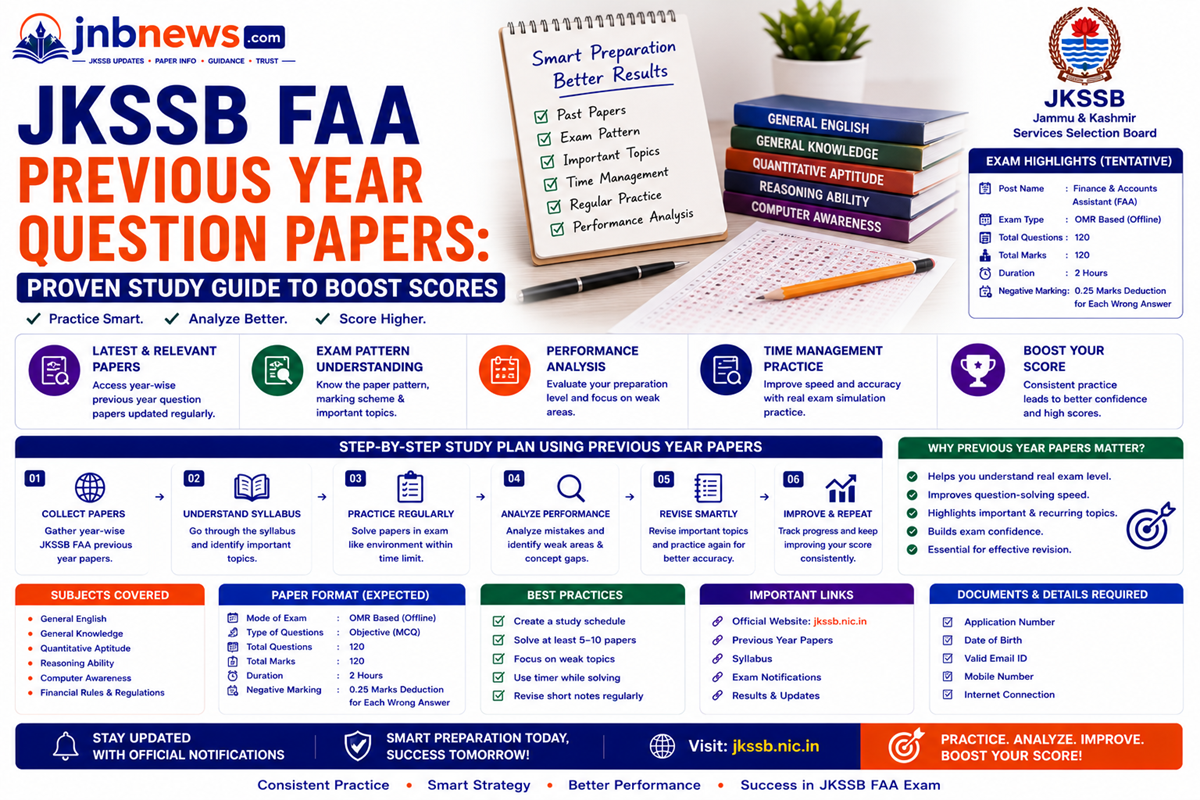
JKSSB FAA Previous Year Question Papers: Proven Study Guide to Boost Scores
Quick Answer
To build a massive competitive edge across regional civil service cycles, analyzing JKSSB FAA Previous Year Question Papers is an absolute strategic necessity. The Jammu and Kashmir Services Selection Board tests candidates for the Finance Accounts Assistant (FAA) cadre via a rigorous 120-mark objective written examination. Reviewing archival question sets allows aspirants to decode the precise topic distribution and recurring difficulty benchmarks enforced across key cycles—including the baseline exams from 2022 and 2024. Candidates can examine core question structures, check syllabus adjustments, and build high-yield revision templates smoothly by downloading official files directly from the Official JKSSB Government Portal.
Introduction
Stepping out onto the intensive path toward securing a highly decorated clerical or financial post within the Jammu and Kashmir administration is an ambitious career milestone. For thousands of competitive test-takers across the Union Territory, true clarity does not come from scanning general textbooks or relying on unverified internet chat predictions. Instead, true mastery begins by analyzing the structural boundaries of JKSSB FAA Previous Year Question Papers.
Relying entirely on theoretical definitions without reviewing how concepts are actually framed in past tests can cause major time management issues on exam day.
To keep your professional development schedule completely organized, this comprehensive manual provides an authentic approach to breaking down past test papers. By pairing a personal candidate workspace tracking routine with official examination frameworks, we break down high-weightage section boundaries, detail negative scoring rules, and show you how to structure your core revision notes with complete peace of mind.
Navigating the Examination Menu Pipeline
Staying fully informed during high-stakes preparation runs becomes incredibly simple when you follow a structured sequence. Official civil service documents are arranged in a specific order to streamline your tracking process:
- Exam Notifications & Job Advertisements: The primary structural files that outline active job openings, specific reservation grids, and age parameters.
- Admit Card Releases & Answer Keys: Operational assets required to verify your local testing center coordinates, check your responses against official solution sheets, and calculate score ranges.
- Result Announcements & Deployment Updates: Post-exam processing files used to view final cut-off listings, download detailed marksheets, and monitor provisional department assignments.
The Importance of Root-Level Verification
While using aggregated tracking resources keeps your monthly timeline organized, serious financial cadres must consistently execute root-level confirmations. Vital changes regarding updated exam schemes, revised answer keys, or mandatory physical verification documents must always be checked directly on the official state portal before finalizing your core revision models. This protective routine shields your candidate profile from unverified web modifications.
Technical Layout of the 120-Mark Core Syllabus
Succeeding under modern Union Territory civil service cycles requires matching your textbook study patterns with the exact operational standards checked by past papers. The selection architecture uses a rigid 120-point objective written layout broken down into specialized high-yield components:
[JKSSB FAA 120-Mark Matrix] ──> Bookkeeping & Accountancy (30 Marks — Highest Weight)
                            ──> GK with Special Reference to J&K UT (30 Marks)
                            ──> General Science: Physics, Chem, Bio (10 Marks)
                            ──> Mathematics & Statistics (20 Marks)
                            ──> Basic Economics & Computers (30 Marks Combined)
1. High-Volume Specialized Sections
The single most critical pillar within JKSSB FAA Previous Year Question Papers is Bookkeeping and Accountancy (30 Marks). This segment demands deep conceptual clarity regarding Cash Books, Financial Statements, Ledger Posting, Partnership Accounts, and Social Accounting techniques. It runs parallel to General Knowledge with special reference to J&K UT (30 Marks), which focuses heavily on regional history, geography, hydro-electric projects, and the J&K Reorganisation Act.
2. Analytical and Technical Foundation Sections
The remaining marks are distributed to evaluate data-handling and scientific reasoning skills. This includes Knowledge of Computers (10 Marks), General Science (10 Marks), Mathematics (10 Marks), and Economics (10 Marks). Past papers consistently reveal that candidates who master numerical problem-solving rules across Statistics and Accountancy secure the highest standings on the final selection list.
Crucial Evaluation and Scoring Parameters
Succeeding under the active examination framework requires matching your revision drills with the exact testing protocols verified by computerized grading systems.
Pure Written-Merit Frameworks
To guarantee absolute operational transparency, final placement inside the recruitment roster is determined purely by merit performance in the objective written examination. The board completely operates without separate oral interviews or viva-voce marks for this portfolio. Your performance on the OMR answer sheets serves as the absolute deciding factor for matching your profile with final appointment recommendations.
Detailed OMR Scoring and Penalty Layouts
The written screening paper prints exclusively in the English language and contains 120 multiple-choice questions to be solved over a strict 2-hour (120 minutes) execution window. For every incorrect choice recorded on your answer sheet, a strict negative marking penalty of one-fourth (25% or 0.25 marks) is automatically deducted from your raw score total. Blank, unattempted rows incur zero penalty marks, making precision accuracy highly critical.
Step-by-Step Blueprint to Extract High-Yield Notes
Follow this practical, code-compliant routine to analyze past papers, map out recurring trends, and compile your core study materials safely.
1. Download Authentic Master Papers
Pull unedited question archives straight from primary government storage servers to ensure your materials are completely valid.
- Open your internet browser window and navigate straight to the Official JKSSB Government Portal.
- Locate the ‘Downloads’ tab or type ‘Accounts Assistant Question Paper’ into the central search utility.
- Save the master question booklets alongside their verified final answer keys to your local storage drive.
2. Isolate Recurring Concept Traps
Map out your daily study blocks by sorting past questions into clear topic categories.
- Open past question files and jump straight to the Accountancy section. Isolate recurring numerical items involving depreciation accounting methods, bank reconciliation statements, and error rectification codes.
- In the General Knowledge section, track how the board frames questions on the J&K Reorganisation Act to ensure your notes match the exact technical details expected.
3. Track Auxiliary Regional Resource Linkages
To access additional background analyses and external reporting covering regional civil service updates, view our specialized tracking partners:
- Read More Information on https://jnbnews.com
Common Pitfalls Candidates Must Avoid
Protect your preparation timeline from common strategic errors by keeping these critical pitfalls in mind.
Entering Inaccurate Data Values Inside Your Profile
Entering incorrect graduation percentages or selecting the wrong community category options just to complete a form quickly can cause serious issues later. Even if you clear the high cut-off scores of the written phases, any mismatch between your digital form data and your physical certificates will lead to immediate disqualification during document verification. Treat every profile entry with absolute accuracy.
Relying on Passive Reading Without Timed OMR Practice
Assuming that simply reading past questions and reviewing the answers is enough to pass is a major mistake. Real exam-room pressure impacts your processing speed across long financial entries and mathematical calculations. You must practice solving JKSSB FAA Previous Year Question Papers under a strict 120-minute countdown timer using physical OMR sheets to manage your time effectively on test day.
Comprehensive Syllabus Weightage Matrix
The detailed table below outlines the core topic parameters established across past selection cycles.
| Specialized Syllabus Section | Maximum Marks | Key High-Yield Core Focus Topics | Expected Question Style |
| Bookkeeping & Accountancy | 30 Marks | Ledger Posting, Trial Balance, Depreciation | Conceptual & Numerical |
| General Knowledge (J&K UT) | 30 Marks | Climate, History, Reorganisation Act, Culture | Factual & Current Events |
| Mathematics & Statistics | 10 Marks | Matrices, Probability, Linear Equations | Pure Problem Solving |
| Economics & Computers | 30 Marks | Demand/Supply, Hardware/Software, Internet | Basic Applied Theory |
Pros and Cons of Archival Paper Analysis
Pros
- Decodes Real Difficulty Levels: Keeps your study blocks accurately aligned with real exam standards, preventing you from over-preparing for minor topics.
- Highlights High-Yield Sections: Clearly shows you which chapters within Accountancy and GK provide the highest return on investment.
- Reduces Negative Marking Errors: Regular practice allows you to refine your elimination strategies, cutting down on penalty deductions.
Cons
- Requires Monitoring Current Updates: While historical papers provide an excellent structural blueprint, you must supplement your notes with fresh current affairs updates.
Frequently Asked Questions
Where can I download official JKSSB FAA Previous Year Question Papers?
The unedited archival question papers and verified final answer keys can be downloaded directly from the official notification database on the Official JKSSB Government Website.
What is the maximum scoring weightage under the FAA written exam pattern?
The offline, OMR-based written examination distributes a maximum allocation of 120 marks across 120 multiple-choice questions.
Which individual section carries the highest weightage in the syllabus?
The curriculum places the highest emphasis on two primary pillars carrying 30 marks each: Bookkeeping & Accountancy and General Knowledge with special reference to J&K UT.
What is the negative marking penalty enforced for wrong objective choices?
For every incorrect option marked on your OMR sheet, a strict negative penalty of one-fourth (25% or 0.25 marks) is automatically deducted.
Does the selection process feature a personal interview round?
No. Selections for the Finance Accounts Assistant cadre are determined purely by merit performance in the written OMR test.
What math and stats topics are highlighted in past papers?
Past papers show regular questions covering Matrices, Determinants, Probability, Measures of Central Tendency, and Index Numbers.
Are higher qualification holders eligible to apply for this post?
Yes. The baseline eligibility requirement is a Graduation Degree in Commerce, Science, Arts, or Computer Applications from a recognized university.
Is a local domicile certificate mandatory for final selection?
Yes. Every candidate must hold a valid Domicile Certificate of the UT of Jammu and Kashmir issued by competent revenue officers to claim a seat.
What is the base starting salary scale assigned to a selected FAA?
Selected accounts professionals enter service under Pay Level-4 (Scale ₹25,500 – ₹81,100) along with standard allowances authorized by the UT administration.
How often should candidates practice full-length past mock papers?
Integrating a full-length, timed past paper drill once or twice a week during your final revision blocks is highly effective for building exam-room speed and confidence.
Final Verdict
Analyzing JKSSB FAA Previous Year Question Papers systematically is the critical first milestone toward securing a top rank on the final public service merit roster. By moving away from unverified social media chatter and using an organized, step-by-step approach through official portals, you can keep your preparation schedule perfectly on track. This systematic focus protects your study notes from outdated templates and ensures your revision aligns perfectly with current requirements, letting you approach the upcoming test with complete confidence.
If you are ready to review your resource layouts or check current exam pattern adjustments, make the official state application servers a regular stop in your routine. By keeping your administrative timeline perfectly organized, you can approach your technical goals with peace of mind and secure your digital business milestones smoothly.
Technical Resources and References
External References
Review official notification logs, structural changes, and candidate system frameworks directly from primary state authorities:
- Jammu and Kashmir Services Selection Board Document Archives: https://jkssb.nic.in/
- JKSSB Online Candidate Portal Login Terminal: https://jkssb.nic.in/candidate/login
Read More Information on https://jnbnews.com