
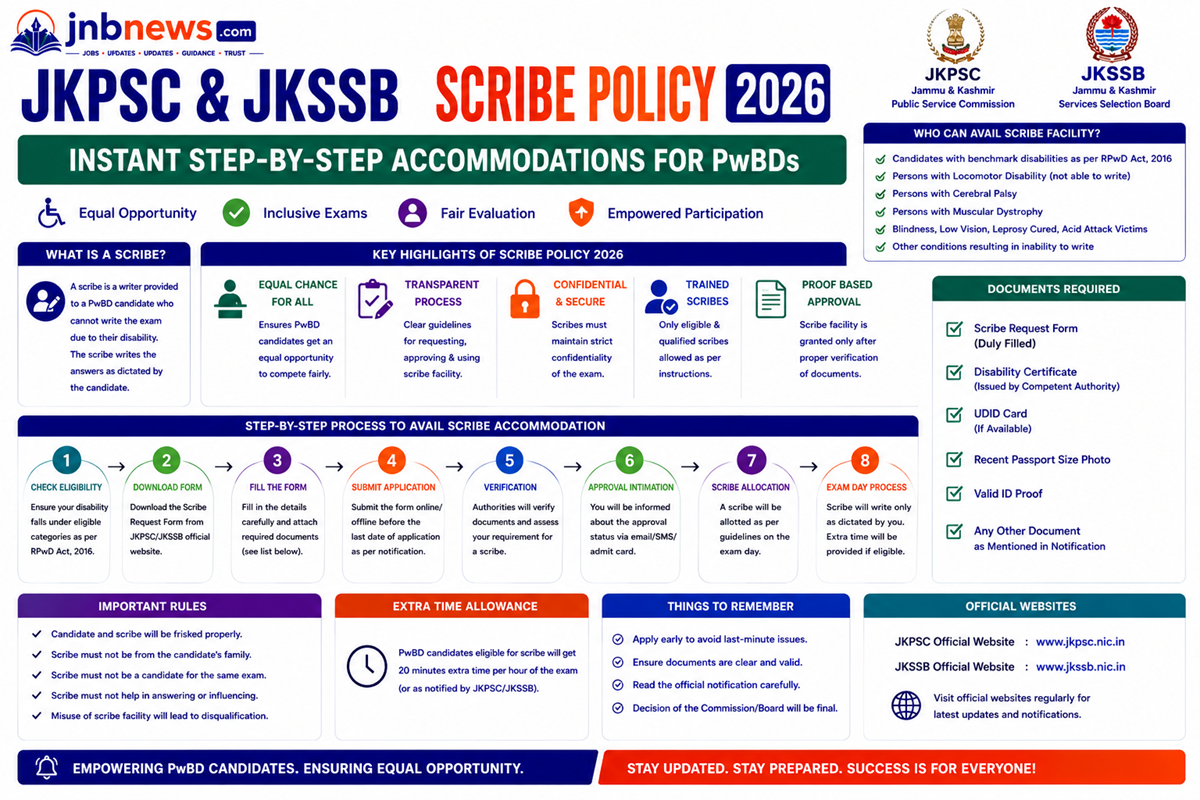
JKPSC & JKSSB Scribe Policy 2026: Instant Step-by-Step Accommodations for PwBDs
Quick Answer
To build a highly structured administrative advantage ahead of competitive state tests, following the JKPSC & JKSSB Scribe Policy 2026 protocols is an absolute legal necessity. Officially structured in accordance with Section 2(r) of the Rights of Persons with Disabilities (RPwD) Act 2016, the Jammu and Kashmir Public Service Commission (JKPSC) and the Services Selection Board (JKSSB) have activated integrated accommodation protocols for the current testing cycle. Eligible Persons with Benchmark Disabilities (PwBDs) facing physical limitations in writing are legally entitled to an additional compensatory time allocation of 20 minutes per hour of examination, alongside independent scribe allocation gates. Candidates can verify active notice criteria, download mandatory annexure forms, and trace file submission deadlines smoothly by visiting the Official JKPSC Government Portal.
Introduction
Stepping onto the competitive preparation path for elite administrative, clinical, or secretarial positions within the Jammu and Kashmir public sector is a significant career milestone. For hundreds of resilient aspirants competing under specialized disability classifications across the Union Territory, true professional progression requires a thorough understanding of the formal JKPSC & JKSSB Scribe Policy 2026 directives. True career security cannot rely on casual forum discussions or social media rumors; it demands a precise look at the specific application timelines, medical certifications, and physical constraints verified by state evaluation panels.
Relying on incomplete medical documents or delaying your scribe registration files can lead to administrative rejections, causing you to lose your accommodations on exam morning.
To keep your professional timeline completely organized, this comprehensive guide outlines an authentic approach to securing your testing accommodations. By pairing your personal candidate workspace actions with official statutory guidelines, we break down how scribe eligibility parameters are mapped out, explain compensatory pacing formulas, and show you how to organize your verification folders with complete peace of mind.
Navigating the Examination Menu Pipeline
Staying fully informed during high-stakes preparation runs becomes incredibly simple when you follow a structured sequence. Official civil service notifications are arranged in a specific order to streamline your tracking process:
- Exam Notifications & Job Advertisements: The primary structural files that outline active job openings, specific reservation grids, and age parameters.
- Admit Card Releases & Accommodation Notices: Operational assets required to verify your local testing center coordinates, check approved scribe authorizations, and review compensatory timing parameters.
- Result Announcements & Merit Roster Lists: Post-exam processing files used to view final cut-off listings, analyze selection rosters, and view provisional department assignments.
The Importance of Root-Level Verification
While using aggregated tracking resources keeps your monthly timeline organized, serious administrative aspirants must consistently execute root-level confirmations. Vital changes regarding shifting medical board dates, descriptive re-totaling deadlines, or physical certificate parameters must always be checked directly on the official state portal before finalizing your core revision models. This protective routine shields your candidate profile from unverified web modifications.
Technical Architecture of the 2026 Disability Framework
The structural layout under the JKPSC & JKSSB Scribe Policy 2026 matrix enforces a standardized processing pathway across all major Union Territory evaluation streams—including the Combined Competitive Examination (CCE) and localized departmental tests.
[PwBD Entry Phase] ──> Category A: Blindness / Locomotor / Cerebral Palsy ──> Automatic Scribe Right
                   ──> Category B: Remaining Specialized Conditions        ──> Chief Medical Certificate Gate
                                                 │
[System Allocation] ──> Verification Complete ──> +20 Minutes Per Hour Compensatory Time Extension
1. Automatic Scribe Authorization Streams
In compliance with the Jammu and Kashmir Public Service Commission (Conduct of Examination) rules, candidates falling under clear, specific categories—including blindness, locomotor disability (where both arms are affected), and cerebral palsy—are granted the right to utilize a scribe automatically upon selecting the option inside their active digital profiles.
2. Discretionary Certificate Verification Streams
For remaining medical categories classified under the RPwD Act 2016, the facility of a scribe and compensatory timing remains available provided the applicant presents clear documentation. This pathway requires producing a valid physical limitation certificate from an authorized Chief Medical Officer (CMO) confirming that the candidate has a physical constraint that prevents them from writing at standard speeds.
Crucial Pacing and Scribe Qualification Parameters
Succeeding under modern Union Territory civil service cycles requires matching your technical routines with the exact operational standards checked by commission parameters.
Standard Compensatory Time Multipliers
To guarantee absolute fairness across high-stakes examination loops, the commission applies a fixed mathematical time extension formula for eligible PwBD candidates:
- Standard 2-Hour (120 Minutes) MCQs: Entitles the candidate to an additional 40 minutes of testing time, extending the session to 160 minutes.
- Standard 3-Hour (180 Minutes) Descriptive Papers: Entitles the candidate to an additional 60 minutes of testing time, extending the session to 240 minutes.
Scribe Educational Prerequisite Guardrails
To prevent academic inflation and guarantee testing integrity, strict qualifications apply to the person serving as the scribe. The educational level of the assigned scribe must be strictly one step below the minimum eligibility criteria advertised for the targeted post. For instance, if an engineering or administrative opening mandates a Graduation Degree baseline, the scribe must not have cleared any qualification higher than a 10+2 Higher Secondary certificate.
Step-by-Step Blueprint to Secure Your Accommodations
Follow this practical, code-compliant routine to connect with the commission’s servers, manage your candidate settings, and pull your verification documents safely.
1. Download the Mandatory Physical Limitation Proformas
Pull authentic, unedited blueprint files straight from primary government storage servers to ensure your materials are completely valid.
- Open your internet browser window and navigate straight to the Official JKPSC Government Portal.
- Locate the central ‘What’s New’ updates block or hover over the examination notification index tabs.
- Select the notice tracking Facility of Scribe and Compensatory Time for Persons with Benchmark Disabilities to save the master text along with Annexure-A straight to your local drive.
2. Secure Authorized Medical Signatures
Complete your physical authentication loops early to pass automated gate filters.
- Print out the official Annexure-A form block on clean white paper.
- Visit the regional state hospital to present your case before the Standing Medical Board or a designated Chief Medical Officer.
- Ensure the medical officer fills in your exact legal name, states your precise percentage of disability, signs the ledger, and applies the official office round stamp.
3. File the Hard-Copy Application Package
Deliver your completed verification files to the commission’s headquarters well ahead of the specified deadlines.
- Draft a formal application on plain paper addressed to the Controller of Examinations.
- Attach your self-attested Disability Certificate, your completed Annexure-A proforma, a copy of your active examination admit card, and a valid photo ID card.
- Submit the complete folder package to the physical board offices to ensure your candidate profile is formally approved for compensatory time extensions.
Common Pitfalls Candidates Must Avoid
Protect your preparation timeline from common administrative errors by keeping these exam-stage pitfalls in mind.
Entering Inaccurate Data Values Inside Your Profile
Entering incorrect graduation percentages or selecting the wrong community category options just to complete a form quickly can cause serious issues later. Even if you clear the high cut-off scores of the written phases, any mismatch between your digital form data and your physical certificates will lead to immediate disqualification during document verification. Treat every profile entry with absolute accuracy.
Utilizing a Scribe with Unverified Higher Qualifications
Assuming that using an over-qualified friend or private tutor as your scribe will go unnoticed by exam supervisors is a high-risk error. The commission runs strict background and document verification checks on scribes on test morning. If the scribe is found to hold degrees matching or exceeding the candidate baseline, the applicant will face immediate disqualification and can be barred from all future state selections under fraudulent claim clauses.
Comprehensive Accommodations Balance Matrix
The detailed comparative table below outlines the core parameters established under the active 2026 administrative cycles.
| Disability Cadre Category | Required Validation Document | Base Time Extension Allowance | Upper Scribe Academic Cap | Core System Status |
| Blindness & Cerebral Palsy | Valid RPwD Disability Card | 20 Minutes Per Hour | One Step Below Exam Baseline | Approved automatically upon profile check |
| Remaining PwBD Classes | Official CMO Annexure-A Proforma | 20 Minutes Per Hour | One Step Below Exam Baseline | Requires manual verification by board panels |
Pros and Cons of Curated Accommodation Tracking
Pros
- Eliminates Gate Timing Panic: Organizing your certificates and proformas weeks ahead of time ensures your portal submission goes smoothly.
- Clarifies Pacing Strategies: Breaks down the exact compensatory time multipliers clearly so you can pace your practice tests accurately.
- Protects Legal Rights: Gives you direct access to the latest RPwD compliance notices, ensuring you receive your full testing accommodations.
Cons
- Requires Physical Document Handing: Curation guides provide the forms, but obtaining CMO signatures and delivering the completed application package always requires physical handling.
Frequently Asked Questions
Where can I check the official JKPSC & JKSSB Scribe Policy 2026 notices?
The comprehensive guidelines, proforma sheets, and submission updates can be accessed directly via the main updates panel on the Official JKPSC Government Website.
What is the exact compensatory time extension provided to eligible candidates?
Shortlisted PwBD candidates receive an additional 20 minutes of compensatory time for every individual hour of testing duration.
How much extra time does an applicant get for a standard 2-hour objective paper?
An eligible candidate receives an additional 40 minutes, extending their total testing block to 160 minutes.
Who is the competent authority authorized to sign the physical limitation certificate?
The certificate (Annexure-A) must be formally filled out, signed, and stamped by an authorized Chief Medical Officer (CMO) or a competent state medical board.
What is the strict educational qualification ceiling enforced for a scribe?
The scribe’s educational level must be strictly one step below the minimum baseline qualification required for the position.
Can a candidate bring their own scribe to the state testing center?
Yes. Candidates have the right to opt for their own scribe by submitting an undertaking layout, or they can request the commission to provide a scribe well ahead of the exam date.
What happens if a candidate submits a fraudulent disability claim?
Any candidate caught making a fraudulent claim of PwBD status will be immediately debarred from the exam and will face long-term bans from future state jobs.
Is the lower application fee applicable to PwBD candidates across all notices?
Yes. Across most active selection notifications, general Open Merit fees land at ₹600, while PwBD candidates pay a lower fee of ₹500.
What physical documents must be presented at the gate on exam morning?
A approved candidate must present their physical admit card, their official scribe authorization pass, and a valid original government-issued photo ID card.
How frequently should candidates check for upcoming accommodation schedules?
Reviewing official portal updates two to three times a week ensures you stay well ahead of live submission windows, center adjustment notices, and scribe card download timelines early.
Final Verdict
Navigating the JKPSC & JKSSB Scribe Policy 2026 framework systematically is an essential first milestone toward securing a stable public service career. By moving away from unverified social media chatter and using an organized, step-by-step approach through official portals, you can keep your preparation schedule perfectly on track. This systematic focus protects your candidate profile from unexpected accommodation drops and ensures your technical documentation aligns with current requirements, letting you approach the upcoming test with complete confidence.
If you are ready to review your qualifications or check your target department codes, make the official government server links a regular stop in your daily routine. By keeping your administrative timeline perfectly organized, you can approach your technical goals with peace of mind and secure your milestones smoothly.
Technical Resources and References
External References
Review official notification logs, structural changes, and candidate system frameworks directly from primary state authorities:
- Jammu and Kashmir Public Service Commission Notice Archives: https://jkssb.nic.in/
- JKPSC Candidate Dashboard Account Login Terminal: https://www.jkpsc.nic.in/pages/login.aspx
Read More Information on https://jnbnews.com