
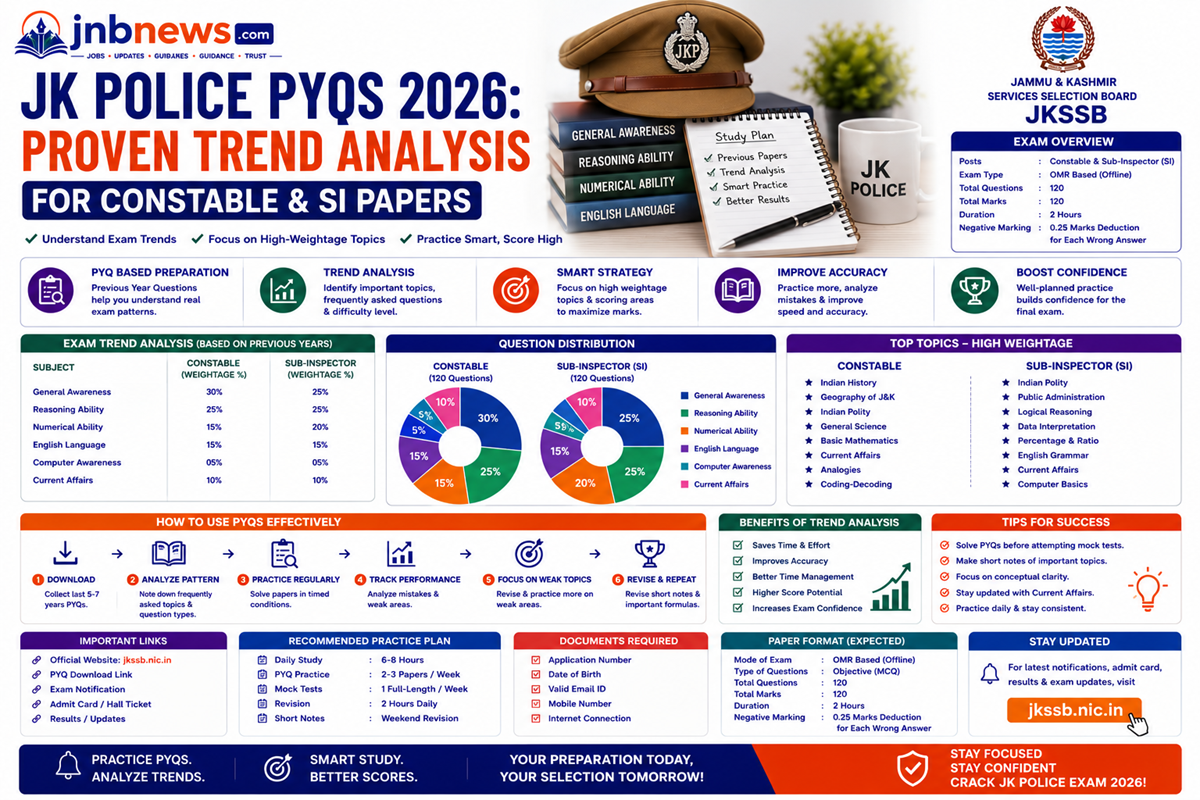
JK Police PYQs 2026: Proven Trend Analysis for Constable & SI Papers
Quick Answer
To build an absolute competitive edge across uniform executive cadres, breaking down historical JK Police PYQs 2026 datasets is a vital strategic milestone. Managed by the Jammu and Kashmir Services Selection Board, the selection pathways for both Constable (Executive/Armed/Technical) and Sub-Inspector (SI) cadres rely on rigorous objective written tests before moving to physical efficiency gates. Analyzing archival question loops—spanning the highly competitive 2022 and 2024 testing cycles—allows aspirants to map core question trends, track subject-wise difficulty ranges, and align their textbook notes perfectly. Candidates can access primary selection calendars, check official answer key solutions, and save unedited question papers safely by visiting the Official JKSSB Government Portal.
Introduction
Securing a stable, highly decorated uniform post as a Constable or Sub-Inspector within the Jammu and Kashmir Police force is an elite career milestone. For thousands of physical and technical contenders across the Union Territory, true clarity during long preparation months does not come from scanning general reference books or following speculative social chat predictions. Instead, high-yield preparation requires structural practice with authentic JK Police PYQs 2026 collections.
Relying entirely on abstract formulas without understanding how the board frames its regional general knowledge and logical puzzles can cause major pacing issues during real test sessions.
To keep your professional development schedule completely organized, this comprehensive guide provides an authentic approach to breaking down past uniform papers. By combining a systematic candidate workspace routine with official commission parameters, we break down high-volume section boundaries, detail negative marking guidelines, and show you how to compile your core study notes with complete peace of mind.
Navigating the Examination Menu Pipeline
Staying fully informed during high-stakes preparation runs becomes incredibly simple when you follow a structured sequence. Official civil service documents are arranged in a specific order to streamline your tracking process:
- Exam Notifications & Job Advertisements: The primary structural files that outline active job openings, specific reservation grids, and age parameters.
- Admit Card Releases & Answer Keys: Operational assets required to verify your local testing center coordinates, check your responses against official solution sheets, and calculate score ranges.
- Result Announcements & Physical Calendars: Post-exam processing files used to view final cut-off listings, check shortlists for Physical Endurance Tests (PET), and track provisional appointments.
The Importance of Root-Level Verification
While utilizing curated notification platforms keeps your study schedules organized, serious uniform aspirants must consistently cross-reference data inputs with root government servers. Critical shifts regarding physical measurement metrics, revised syllabus scripts, or test venue parameters must always be verified straight from primary board releases before making final career updates. This protective routine shields your profile from unverified web modifications.
Structural Comparison of JKP Uniform Exam Layouts
Analyzing JK Police PYQs 2026 archives highlights clear structural updates implemented by the selection board across varying administrative pay matrix levels.
1. The Constable Written Examination Architecture
The written framework for the Constable entry tier comprises a 100-mark objective paper containing 100 questions to be solved inside a strict 2-hour window. The topic matrix splits points smoothly across five primary pillars:
- General English Proficiency (25 Questions)
- General Knowledge & Current Affairs of India (25 Questions)
- Numerical & Logical Reasoning Ability (25 Questions)
- Basic Concepts of Computers (15 Questions)
- GK & Current Affairs with special reference to J&K UT (10 Questions)
2. The Sub-Inspector (SI) Written Screening Track
For the higher uniform tiers, past papers reveal an expanded evaluation structure. The Sub-Inspector screening test contains 120 objective multiple-choice items mapping out a 120-mark total base. The questions dig deeper into advanced topics like the Indian Constitution, international organizations (UN, SAARC, ASEAN), general science principles, and detailed tracking of economic development parameters.
Crucial Selection and Marking Parameters
Succeeding under the active examination framework requires matching your revision drills with the exact testing protocols verified by computerized grading systems.
Pure Written-Merit Selection Rules
To ensure complete transparency across all uniform cadres, final shortlists for the mandatory physical endurance tests are determined purely by merit performance in the objective written examination. The commission completely operates without subjective interview filters across these tiers. Your marked OMR answer sheet serves as the absolute benchmark for matching your candidate profile with final provisional rosters.
Rigorous Negative Marking Penalties
The objective question booklets print exclusively in the English language. For every incorrect choice recorded on your answer sheet, a strict negative marking penalty of one-fourth (25% or 0.25 marks) is automatically deducted from your accumulated total score. Blank, unattempted rows do not trigger deduction flags, making precision far more valuable than random volume guessing during timed mock drills.
Step-by-Step Blueprint to Map Exam Trends
Follow this practical, code-compliant routine to extract past question files, identify high-yield chapters, and configure your study trackers safely.
1. Download Master Archival Material From Primary Servers
Pull unedited question archives straight from primary government storage servers to ensure your materials are completely valid.
- Open your web browser window and navigate directly to the Official JKSSB Government Website.
- Locate the central ‘Downloads’ index or type your targeted post code search strings into the news feed bar.
- Save the master question booklets alongside their verified final answer keys straight to your local drive storage.
2. Isolate Regional J&K General Knowledge Trends
Prioritize your daily reading blocks by charting out specific topic weights that frequently trip up casual applicants.
- Open past papers and navigate directly to the J&K specific modules. Isolate recurring historical questions covering important tourist destinations, local rivers/lakes, and regional power projects.
- Review the specific provisions of the Right to Information (RTI) Act and the Indus Water Treaty, as past testing cycles focus heavily on these administrative anchors.
3. Track External Reporting Networks
To access additional background analyses and external reporting covering regional civil service updates, view our specialized tracking partners:
- Read More Information on https://jnbnews.com
Common Pitfalls Candidates Must Avoid
Protect your preparation timeline from common administrative errors by keeping these exam-stage pitfalls in mind.
Entering Inaccurate Data Values Inside Your Profile
Entering incorrect graduation percentages or selecting the wrong community category options just to complete a form quickly can cause serious issues later. Even if you clear the high cut-off scores of the written phases, any mismatch between your digital form data and your physical certificates will lead to immediate disqualification during document verification. Treat every profile entry with absolute accuracy.
Ignoring Your Physical Fitness Routines During Written Revision
Assuming that you can easily configure your physical stamina in the brief window after written results are published is a critical error. The physical endurance test involves strict timed running metrics (1600 meters under 6.5 minutes for males, 1000 meters for females), alongside push-up and shot-put gates. Maintain a balanced daily timeline that pairs morning endurance drills with your evening textbook revisions.
Comprehensive Recruitment Comparison Matrix
The detailed comparative table below outlines the core parameters established across active uniform selection tracks.
| Uniform Post Cadre Track | Maximum Marks Basis | Total Question Items | Negative Score Penalty | Core Physical Entry Requirement |
| JKP Constable Tier | 100 Total Marks | 100 Questions | Strict 0.25 Reduction | 1600m/1000m Race + Push-ups/Shot-put |
| JKP Sub-Inspector | 120 Total Marks | 120 Questions | Strict 0.25 Reduction | 1600m/1000m Race + Physical standard matching |
Pros and Cons of Archival Paper Analysis
Pros
- Decodes Question Presentation: Helps you understand exactly how the board frames its reasoning and computer questions, moving your focus beyond basic definitions.
- Optimizes Time Management: Gives you a clear idea of how to balance your time across 100 to 120 questions before stepping into the exam hall.
- Exposes High-Yield Chapters: Highlights recurring topics within basic arithmetic and regional history, allowing you to maximize your study efficiency.
Cons
- Demands Fresh Current Affairs Updates: Past papers establish an excellent structural blueprint, but you must constantly update your notes with current national and international events.
Frequently Asked Questions
Where can I check official JK Police PYQs 2026 archives securely?
The unedited question sets and verified final answer key sheets can be downloaded straight from the notification section on the Official JKSSB Government Portal.
What is the written exam score weightage for the Constable post?
The written screening exam for the Constable cadre distributes a maximum weightage of 100 marks across 100 objective questions.
How many questions are compiled inside the Sub-Inspector written test booklet?
The Sub-Inspector written screening exam uses an expanded layout comprising 120 objective questions mapping out a 120-mark base.
What negative marking penalty is enforced for wrong objective choices?
For every incorrect choice recorded on your OMR sheet, a negative penalty of one-fourth (25% or 0.25 marks) is automatically deducted.
Does the final uniform selection process include a personal interview?
No. Selections for both Constable and Sub-Inspector tracks are determined purely by written exam merit combined with clearing the mandatory physical gates.
What running distance is required to clear the physical endurance test?
Male candidates must complete a 1600-meter race within 6.5 minutes, while female candidates face a 1000-meter track to be completed in 6.5 minutes.
Is a local domicile certificate required to clear these selection gates?
Yes. Every candidate must hold a valid Domicile Certificate of the UT of Jammu and Kashmir issued by competent revenue officers to remain eligible for appointment.
Can an applicant apply for technical uniform posts with general qualifications?
Specialized tracks like Telecommunications or Photography require matching technical knowledge baselines—such as specific ITI certifications or diploma strings outlined in the master advertisement.
What is the maximum age boundary enforced for general Open Merit applicants?
The standard upper age threshold for general Open Merit (OM) entries is locked at 28 years old for standard uniform posts, subject to specific relaxations listed in the official notices.
How often should candidates run through timed past exam simulations?
Integrating a full-length, timed past paper drill once or twice a week using physical OMR sheets is an exceptionally effective routine for building exam-room speed and confidence.
Final Verdict
Analyzing your JK Police PYQs 2026 logs systematically is an essential first milestone toward securing a decorated uniform career within the Jammu and Kashmir Police force. By moving away from unverified social media chatter and using an organized, step-by-step approach through official portals, you can keep your preparation schedule perfectly on track. This systematic focus protects your candidate profile from obsolete study templates and ensures your technical documentation aligns with current requirements, letting you approach the upcoming test with complete confidence.
If you are ready to review your resource layouts or check current exam pattern adjustments, make the official state application servers a regular stop in your routine. By keeping your administrative timeline perfectly organized, you can approach your technical goals with peace of mind and secure your digital business milestones smoothly.
Technical Resources and References
External References
Review official notification logs, structural changes, and candidate system frameworks directly from primary state authorities:
- Jammu and Kashmir Services Selection Board Document Archives: https://jkssb.nic.in/
- JKSSB Online Candidate Portal Login Terminal: https://jkssb.nic.in/candidate/login
Read More Information on https://jnbnews.com