
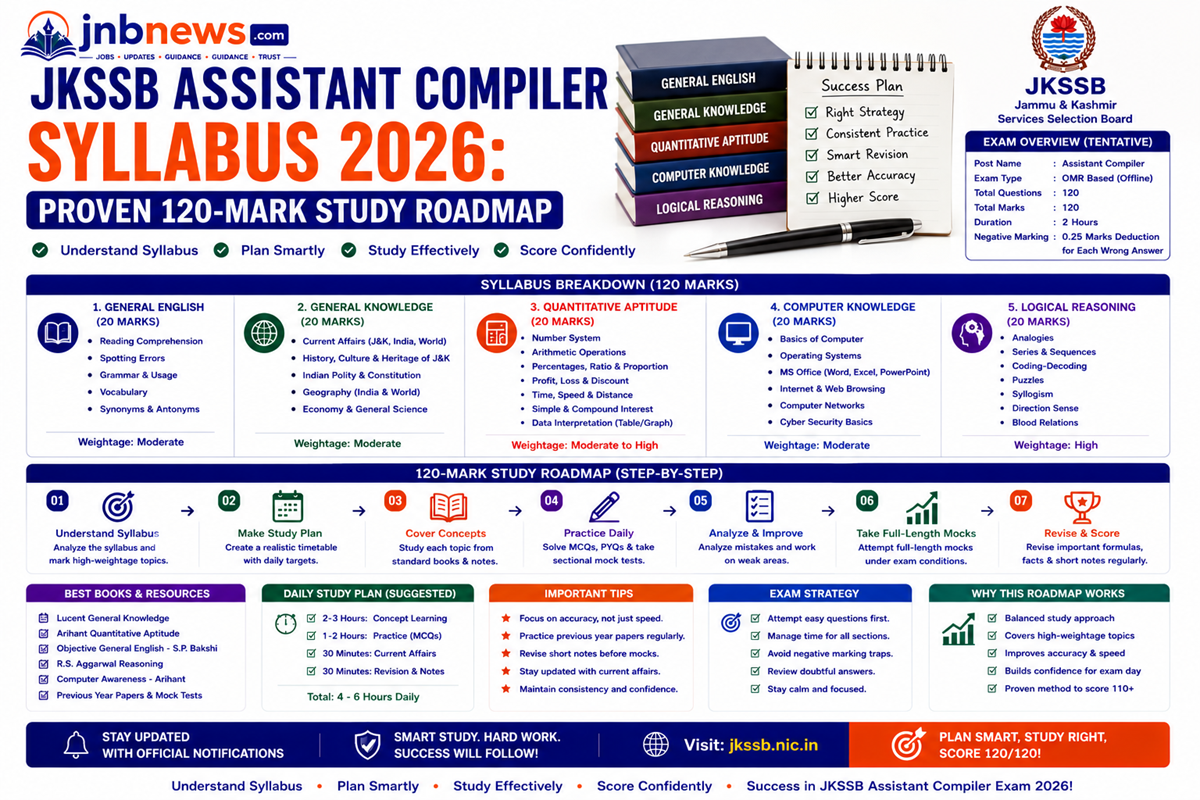
JKSSB Assistant Compiler Syllabus 2026: Proven 120-Mark Study Roadmap
Quick Answer
To build a massive competitive edge ahead of high-stakes Finance Department cycles, decoding the JKSSB Assistant Compiler Syllabus 2026 is an absolute strategic necessity. Formally structured by the Jammu and Kashmir Services Selection Board, the selection framework for this Level-4 uniform and clerical post relies on a strict 120-mark objective written OMR examination followed by a physical document verification round. The core curriculum distributes marks across 8 highly specific units, heavily emphasizing General English (15 marks), Mathematics (15 marks), and General Knowledge with special reference to J&K UT (15 marks). Aspirants can evaluate active examination schedules, check revised topic allocations, and download official notice parameters smoothly by visiting the Official JKSSB Government Portal.
Introduction
Stepping onto the intensive path toward securing a highly decorated position as an Assistant Compiler within the J&K Funds Organisation is an outstanding professional milestone. For thousands of 10+2 and graduate job-seekers across the Union Territory, true clarity during long preparation months does not come from scanning loose reference materials or following speculative social channel predictions. High-yield preparation requires breaking down the exact unit breakdowns, subject weights, and system penalties enforced by state regulators.
Relying entirely on abstract shortcuts without understanding how the board frames its regional general knowledge and surface geometry calculations can cause serious time management errors on exam day.
To keep your professional development schedule completely organized, this comprehensive manual provides an authentic approach to mastering previous evaluation benchmarks. By pairing a personal candidate workspace tracking routine with official statutory metrics, we break down previous 120-mark structures, detail negative marking guidelines, and show you how to compile your core study notes with complete peace of mind.
Navigating the Examination Menu Pipeline
Staying fully informed during high-stakes preparation runs becomes incredibly simple when you follow a structured sequence:
- Exam Notifications & Job Advertisements: The primary structural files that outline active job openings, specific reservation grids, and age parameters.
- Admit Card Releases & Answer Keys: Operational assets required to verify your local testing center coordinates, check your responses against official solution sheets, and calculate score ranges.
- Result Announcements & Merit Roster Lists: Post-exam processing files used to view final cut-off listings, download detailed marksheets, and monitor provisional department assignments.
The Importance of Root-Level Verification
While utilizing curated notification platforms keeps your study schedules organized, serious Finance Department aspirants must consistently cross-reference data inputs with root government servers. Critical shifts regarding test timing rules, technical syllabus updates, or physical document parameters must always be verified straight from primary board releases before making final career updates. This protective routine shields your profile from unverified web modifications.
Comprehensive 120-Mark Unit Distribution
Analyzing the structural blueprint of the JKSSB Assistant Compiler Syllabus 2026 highlights a highly balanced mix of mathematical problem-solving, English language logic, and static general awareness. The 120-point base splits into 8 dedicated focus blocks:
[JKSSB Assistant Compiler 120 Pool] ──> General English (15 Marks)
                                    ──> Basic Mathematics (15 Marks)
                                    ──> GK & Current Affairs (20 Marks)
                                    ──> GK with Special Reference to J&K (15 Marks)
                                    ──> History, Civics, Geography (45 Marks Total)
                                    ──> Mental Ability Test (10 Marks)
Detailed Topic Architecture Per Unit
Unit I: General English (15 Marks)
This section evaluates basic syntax parsing and comprehension mechanics. Focus fields encompass paragraph writing and comprehension passages, editing and proofreading scripts, rearranging jumbled sentences, narration/dialogue modifications, modals and articles, clauses, punctuation markers, synonyms/antonyms, idioms, phrases, and the proper use of prepositions.
Unit II: Mathematics (15 Marks)
This segment demands deep conceptual clarity regarding surface areas and volumes of 3D objects (cubes, cylinders, cones, spheres, and frustums). It runs parallel to the conversion of metallic solids, profit and loss balances, simple and compound interest calculations, linear equations in two variables, arithmetic progressions (AP), probability of single events, and standard BODMAS operations.
Unit III, IV & V: Social Sciences (45 Marks Total)
- History (15 Marks): Focuses heavily on the Revolt of 1857 (causes and effects), the rise of the national movement, the formation of the Indian National Congress (moderates vs. extremists), the Partition of Bengal, the Swadeshi and boycott movements, the Khilafat/Non-Cooperation movements, the Quit India Movement, and final partition metrics.
- Civics (15 Marks): Covers democracy types, Fundamental Rights and Duties, Directive Principles of State Policy, franchise and elections, secret ballot workflows, presidential elections, the United Nations architecture, and urban/rural local governance frameworks.
- Geography (15 Marks): Features the solar system, seasons, latitudes/longitudes, forest types and conservation (especially inside J&K), national parks, water resource management, rainwater harvesting, and critical transport routes across J&K.
Unit VI: General Knowledge & Current Affairs (20 Marks)
The highest single-unit weightage block evaluates global and national developments. Key areas include famous personalities, languages of India, national capitals/currencies, international organizations (UNO, WHO, IMF), regional groups (BRICS, ASEAN, SAARC, G20), space/atomic programs, national power projects, basic macroeconomic indicators (GDP, GNP), awards, honors, and sports milestones.
Unit VII: GK with Special Reference to J&K UT (15 Marks)
This localized section remains highly vital for securing a top rank. Testing parameters encompass regional climate, crops, flora and fauna, major rivers and lakes, important tourist destinations, the history, economy, and culture of J&K, the J&K Panchayati Raj Act 1989 (with amendments), the 73rd and 74th Constitutional Amendments, and the J&K Reorganisation Act 2019.
Unit VIII: Mental Ability Test (10 Marks)
Evaluates logical deductions through number and letter series tracking, coding-decoding structures, direction sense, blood relations, speed/distance/time mathematical reasoning, and statements/conclusions.
Crucial Selection and Evaluation Parameters
Succeeding under modern Union Territory civil service cycles requires matching your technical routines with the exact operational standards checked by system evaluation algorithms.
Pure Exam-Based Selection Rules
To ensure complete transparency, final placement inside the recruitment roster is determined purely by merit ranking in the objective written OMR test. The board operates without separate oral interviews or subjective viva-voce marks across this cadre. Your calculated accuracy on the OMR answer sheets serves as the absolute benchmark for matching your candidate profile with final appointment recommendations.
Rigorous Negative Marking Layouts
The objective written booklets print exclusively in the English language. For every incorrect option marked on your OMR sheet, a strict negative marking penalty of one-fourth (25% or 0.25 marks) is automatically deducted from your accumulated raw score. Unattempted rows carry zero penalty marks, making precision accuracy highly critical during final revision drills.
Step-by-Step Blueprint to Structure Your Strategy
Follow this practical routine to analyze the curriculum tracks, configure your practice trackers, and organize your files safely.
1. Download Master Curricular Documentation
Pull authentic, unedited blueprint files straight from primary government storage servers to ensure your materials are completely valid.
- Open your internet browser and navigate straight to the Official JKSSB Government Portal.
- Locate the central ‘Syllabus’ directory panel on the homepage layout.
- Isolate the specific file tracking the Syllabus for Assistant Compiler, Advt No. 04 of 2020 or recent iterations to save the text straight to your local drive.
2. Isolate Mathematical and Regional Study Blocks
Dedicate specific windows inside your weekly routine to cover high-yield modules systematically.
- Dovetail your daily schedule to practice 3D geometry volume calculations and linear equations for at least 45 minutes to lock in your math score splits.
- Allocate a distinct evening study block to chart out the structural clauses of the J&K Reorganisation Act 2019, as regional legislative questions form the core baseline of the special J&K awareness sections.
3. Track Auxiliary Curation Linkages
To access additional background analyses and external reporting covering regional civil service updates, view our specialized tracking partners:
- Read More Information on https://jnbnews.com
Common Pitfalls Candidates Must Avoid
Protect your preparation timeline from common administrative errors by keeping these exam-stage pitfalls in mind.
Entering Inaccurate Data Values Inside Your Profile
Entering incorrect graduation percentages or selecting the wrong community category options just to complete a form quickly can cause serious issues later. Even if you clear the high cut-off scores of the written phases, any mismatch between your digital form data and your physical certificates will lead to immediate disqualification during document verification. Treat every profile entry with absolute accuracy.
Relying on Passive Rote Memorization for Mental Ability
Assuming that simply reading logical deduction answers is enough to pass is a major mistake. Real exam-room pressure impacts your processing speed across direction diagrams, blood relation charts, and multi-stage number patterns. You must practice solving mental ability problems actively on physical unruled notebooks using a strict countdown timer to manage your time effectively.
Comprehensive Syllabus Weightage Matrix
The detailed table below outlines the core unit parameters established for the active 120-mark evaluation framework.
| Unit Identifier Code | Target Focus Subject Field | Marks Allocated | Expected Question Content Depth | Core Preparation Resource |
| Unit I & II | General English & Mathematics | 30 Marks Combined | 10th/12th Standard Logic & Formulae | Grammar Guides & NCERT Math Tiers |
| Unit III, IV & V | History, Civics & Geography | 45 Marks Combined | Static Academic & Spatial Concepts | Foundational Social Science Manuals |
| Unit VI & VII | General GK & Special J&K GK | 35 Marks Combined | Factual, Current & Regional Statutes | Regional Gazettes & Reorganisation Logs |
| Unit VIII | Mental Ability Reasoning Test | 10 Marks Total | Analytical Deductions & Coding Loops | Timed Logical Pattern Sets |
Pros and Cons of Curated Syllabus Tracking
Pros
- Eliminates Study Vagueness: Breaks down ambiguous general awareness blocks into explicit bulleted lists, keeping your study tracking highly focused.
- Balances Revision Routines: Clearly maps out the point value of every unit so you can distribute your study time proportionally based on actual marks.
- Saves Vital Research Time: Gathers scattered legislative codes and academic modules into a single clean data matrix, freeing up more hours for study.
Cons
- Demands Regular Current Affairs Updates: The blueprint sets the static limits, but tracking current events requires updating your notes with new national and local news weekly.
Frequently Asked Questions
What is the total maximum weightage of the JKSSB Assistant Compiler written exam?
The offline, OMR-based written screening examination distributes a maximum weightage of 120 marks across 120 objective multiple-choice questions.
How many marks are assigned specifically to the General English section?
The language parsing and syntax component under Unit I carries a dedicated weightage of 15 marks.
What mathematical topics are highlighted in the Assistant Compiler blueprint?
The mathematics section (15 marks) focuses on Surface Areas and Volumes, Profit & Loss, Simple/Compound Interest, Linear Equations, Progression, and Probability.
Which section carries the highest individual mark allocation inside this syllabus?
The General Knowledge & Current Affairs section (Unit VI) carries the highest weightage with 20 marks.
What is the negative marking penalty applied to incorrect objective selections?
For every incorrect choice recorded on your answer sheet, a penalty of one-fourth (25% or 0.25 marks) is automatically deducted from your total score.
Are special legislative acts included in the J&K general knowledge section?
Yes. Candidates must thoroughly study the J&K Reorganisation Act 2019 along with the J&K Panchayati Raj Act 1989 (with amendments).
Is there a descriptive section or typing test round for this post?
No. Selections for the Assistant Compiler cadre are determined purely by merit performance in the objective written OMR exam followed by document checking.
Is a local domicile certificate mandatory for final selection?
Yes. Every candidate must hold a valid Domicile Certificate of the UT of Jammu and Kashmir issued by competent revenue officers to remain eligible for appointment.
What is the primary educational baseline required to apply for this post?
The minimum eligibility criteria specified for the Assistant Compiler cadre is a 10+2 (Higher Secondary Intermediate pass) standard from a recognized educational board.
How often should candidates monitor live updates on search networks?
Reviewing official platform notifications two to three times a week ensures you stay well ahead of live exam calendars, admit card downloads, and provisional key rollouts early.
Final Verdict
Analyzing the JKSSB Assistant Compiler Syllabus 2026 architecture systematically is the critical first step toward securing a decorated career within the Finance Department. By moving away from unverified social media chatter and using an organized, step-by-step approach through official portals, you can keep your preparation schedule perfectly on track. This systematic focus protects your candidate profile from obsolete study templates and ensures your technical documentation aligns with current requirements, letting you approach the upcoming test with complete confidence.
If you are ready to review your resource layouts or check current exam pattern adjustments, make the official state application servers a regular stop in your routine. By keeping your administrative timeline perfectly organized, you can approach your technical goals with peace of mind and secure your milestones smoothly.
Technical Resources and References
External References
Review official notification logs, structural changes, and candidate system frameworks directly from primary state authorities:
- Jammu and Kashmir Services Selection Board Document Archives: https://jkssb.nic.in/
- JKSSB Online Candidate Portal Login Terminal: https://jkssb.nic.in/candidate/login
Read More Information on https://jnbnews.com
Reviewing comprehensive structural guide videos can significantly give you a strategic advantage when planning your initial revision notes. This JKSSB Assistant Compiler 120-Mark Syllabus and Strategy Analysis provides a detailed, step-by-step look at the highest-yield subjects, previous question distributions, and specific textbook tracking plans tailored for beginners. This video resource is highly relevant because it features a detailed natural language explanation detailing exactly how to manage your daily math drills and regional law reviews before the official exam calendar blocks open this year.