
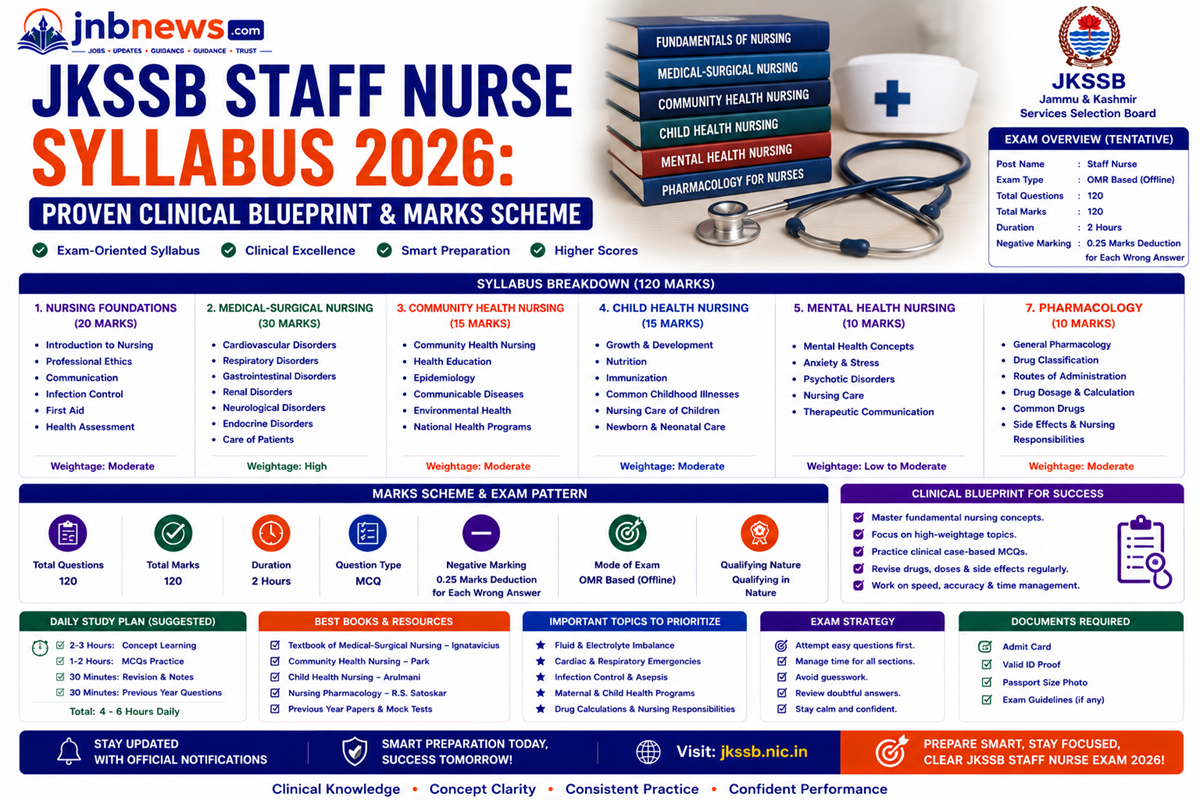
JKSSB Staff Nurse Syllabus 2026: Proven Clinical Blueprint & Marks Scheme
Quick Answer
To build an absolute competitive advantage across regional healthcare divisions, decoding the JKSSB Staff Nurse Syllabus 2026 is an essential strategic milestone. Formally organized by the Jammu and Kashmir Services Selection Board (JKSSB), the evaluation framework for the Level-6 uniform and clinical posts within the Health and Medical Education Department relies on a 150-mark objective written OMR examination followed directly by a physical document verification gate. The comprehensive syllabus allocates specific marks across critical core divisions, heavily emphasizing Nursing Arts & Nutrition (35 marks), Midwifery (30 marks), and Medical-Surgical Nursing (25 marks). Aspirants can evaluate active registration cards, check examination schedules, and download official notice parameters by checking the Official JKSSB Government Portal.
Introduction
Stepping out onto the professional path toward securing a highly decorated clinical or hospital appointment as a Staff Nurse within the public healthcare network of Jammu and Kashmir is a monumental milestone. For thousands of B.Sc. Nursing and Post-Basic nursing graduates across the Union Territory, managing the target checkpoints of the JKSSB Staff Nurse Syllabus 2026 blueprint is the absolute baseline for establishing top merit standings. True career progression does not depend on unverified internet chat speculation or informal forum pages; it demands a structured look at the exact unit blueprints, system penalties, and subject divisions enforced by state regulators.
Relying entirely on abstract shortcuts without understanding complex neurological disorders, aseptic sterilization models, or child development milestones can cause serious diagnostic and marking errors on test day.
To keep your professional development timeline completely organized, this comprehensive manual provides an authentic approach to mastering previous evaluation benchmarks. By pairing a systematic candidate workspace routine with official statutory regulations, we break down high-weightage specialized nursing divisions, outline negative grading rules, and guide you through subsequent administrative milestones with complete peace of mind.
Navigating the Examination Menu Pipeline
Staying fully informed during high-stakes preparation runs becomes incredibly simple when you follow a structured sequence:
- Exam Notifications & Job Advertisements: The primary structural files that outline active job openings, specific reservation grids, and age parameters.
- Admit Card Releases & Answer Keys: Operational assets required to verify your local testing center coordinates, check your responses against official solution sheets, and calculate score ranges.
- Result Announcements & Deployment Updates: Post-exam processing files used to view final cut-off listings, download detailed marksheets, and monitor provisional department assignments.
The Importance of Root-Level Verification
While tracking daily competitive alerts on curation platforms keeps your timeline organized, serious healthcare aspirants must consistently execute root-level confirmations. Vital adjustments regarding shifting testing venue boundaries, mandatory medical checking schedules, or updated qualification rules must always be verified straight from primary board logs to protect your profile standings. This protective routine shields your electronic file from unverified web modifications.
Comprehensive 150-Mark Section Distribution
The scoring architecture under the JKSSB Staff Nurse Syllabus 2026 matrix implements a highly balanced layout designed to measure specialized clinical skill and baseline medical sciences:
[JKSSB Staff Nurse 150 Pool] ──> Nursing Arts & Nutrition (35 Marks — Top Weight)
                              ──> Midwifery & Obstetrical Nursing (30 Marks)
                              ──> Medical-Surgical Nursing (25 Marks)
                              ──> Orthopedic Applied Tiers (20 Marks)
                              ──> Anatomy & Physiology (15 Marks)
                              ──> Sciences: Nutrition / Psych / Micro / Soc (25 Marks Total)
Detailed Content Blueprints for Core Technical Units
1. Anatomy & Physiology (15 Marks)
This foundational module evaluates structural systems and chemical tracking inside the human body. Key areas include the Skeletal and Muscular systems, Nervous system signaling, Digestive and Respiratory tracts, Urinary mechanics, Endocrine regulation, Cardiovascular and Lymphatic blood dynamics, Cell division, and Biochemistry enzymes.
2. Microbiology (05 Marks)
Focuses on infectious agents and hospital safety configurations. Core topics encompass the Cultivation of bacteria, Sterilization and disinfection parameters, Aseptic hospital techniques, Virology, Microscopy, Stains and staining, Control of microbes, and general Medical Microbiology.
3. Medical-Surgical Nursing (25 Marks)
This high-yield section tests clinical interventions across acute systemic conditions. Testing benchmarks include:
- Neurological Disorders: Management of trauma, tumors, and degenerative conditions.
- Systemic Care: ENT disorders, Female reproductive system disorders, and Oncological conditions.
- Specialized Units: Disaster and emergency nursing rules, Critical Care Unit (CCU) management, and Occupational health.
4. Midwifery & Obstetrical Nursing (30 Marks)
Evaluates reproductive health and maternal-child patient care execution. Focus sectors cover the Anatomy/Physiology of the female reproductive system, Fetal development, Antenatal assessment, Normal and abnormal labor management, Postnatal care loops, High-risk pregnancy triggers, Care of the normal/high-risk newborn, and National Family Welfare programs.
5. Nursing Arts, Nutrition, Orthopedics & Social Sciences (75 Marks Total)
- Nursing Arts & Nutrition (35 Marks): Basic nursing foundations, patient recording/charting, ethics, and bedside care techniques.
- Orthopedic Nursing (20 Marks): Applied musculoskeletal pathology, traumatology, applied radiology, and child development.
- Nutrition (10 Marks): Simple/complex carbohydrates, saturated/unsaturated fats, metabolic pathways, and balanced diet planning across life stages.
- Psychology & Sociology (10 Marks Total): Memory/forgetting, coping mechanisms, social stratification, and community health resource mapping.
Crucial Selection and Marking Parameters
Succeeding under modern Union Territory civil service cycles requires matching your technical routines with the exact operational standards checked by commission parameters.
Pure Written-Merit Frameworks
To guarantee absolute operational transparency across all public health cadres, final placement inside the recruitment roster is determined purely by merit performance ranking in the objective written examination. The selection board completely operates without separate oral interviews or subjective panels across these clinical tiers. Your calculated accuracy on the OMR answer sheets serves as the absolute deciding factor for your selection.
Detailed OMR Scoring and Penalty Layouts
The written screening paper prints exclusively in the English language and contains 150 multiple-choice questions to be solved over a strict 150-minute (2.5 hours) window. For every incorrect choice recorded on your answer sheet, a strict negative marking penalty of one-fourth (25% or 0.25 marks) is automatically deducted from your accumulated raw score. Blank rows incur zero penalty points.
Step-by-Step Blueprint to Structure Your Strategy
Follow this practical, code-compliant routine to analyze the curriculum tracks, configure your practice trackers, and organize your files safely.
1. Download Master Curricular Documentation
Pull authentic, unedited blueprint files straight from primary government storage servers to ensure your materials are completely valid.
- Open your internet browser and navigate straight to the Official JKSSB Government Portal.
- Locate the central ‘Syllabus’ directory panel on the homepage layout.
- Isolate the specific file tracking the Syllabus for Staff Nurse (Health and Medical Education Department) to save the text straight to your local drive.
2. Isolate Clinical and Science Study Blocks
Dedicate specific windows inside your weekly routine to cover high-weightage chapters systematically.
- Dovetail your daily schedule to practice Medical-Surgical conditions and Midwifery labor charts for at least 2 hours daily to lock in your highest score splits.
- Allocate a distinct morning study block to master aseptic sterilization steps and cardiovascular anatomy tracking, as basic medical sciences provide the required edge over general applicants.
3. Organize Essential Residency Folders
Ensure your personal credentials pass backend validation checks well before final document verification rounds activate.
- Verify that your Domicile Certificate of the UT of Jammu and Kashmir is issued and stamped by competent revenue authorities, as local residency is a strict prerequisite for final job allocation.
- Keep your original B.Sc. Nursing / Post-Basic degree scrolls and registration certificates organized in a single, secure folder.
Common Pitfalls Candidates Must Avoid
Protect your preparation timeline from common administrative errors by keeping these exam-stage pitfalls in mind.
Entering Inaccurate Data Values Inside Your Profile
Entering incorrect graduation percentages or selecting the wrong community category options just to complete a form quickly can cause serious issues later. Even if you clear the high cut-off scores of the written phases, any mismatch between your digital form data and your physical certificates will lead to immediate disqualification during document verification. Treat every profile entry with absolute accuracy.
Neglecting Baseline Anatomy and Physiology Revisions
Assuming that mastering clinical nursing arts alone is enough to pass without reviewing basic medical sciences is a critical error. Competency tests place major emphasis on the precise anatomical pathways of the endocrine and cardiovascular systems. Skipping these baseline units costs you up to 15 critical marks, easily dropping your profile below the final qualifying line.
Comprehensive Syllabus Weightage Matrix
The detailed table below outlines the core unit parameters established for the active 150-mark evaluation framework.
| Unit Category Focus | Total Marks | Key High-Yield Core Focus Topics | Expected Question Style |
| Nursing Arts & Foundations | 35 Marks | Patient Charting, Nursing Ethics, Bedside Care | Applied Clinical & Ethics |
| Midwifery & Obstetrics | 30 Marks | Antenatal Care, Labor Stages, Neonatal Care | Diagnostic & Procedural |
| Medical-Surgical Nursing | 25 Marks | Neurological, Critical Care, Oncology | Scenario Assessment |
| Orthopedics Applied Tier | 20 Marks | Applied Anatomy, Traumatology, Radiology | Technical Core Theory |
| Anatomy & Basic Physiology | 15 Marks | Skeletal, Circulatory, Nervous Systems | Structural Identification |
| Microbiology & Applied Sciences | 25 Marks | Sterilization, Nutrition, Psychology | Factual Applied Science |
Pros and Cons of Curated Syllabus Tracking
Pros
- Eliminates Study Vagueness: Breaks down ambiguous healthcare guidelines into clear bulleted sections, keeping your study tracking highly focused.
- Balances Revision Routines: Clearly maps out the point value of every unit so you can distribute your study time proportionally based on actual marks.
- Saves Vital Research Time: Gathers scattered clinical codes and medical science components into a single clean data matrix, freeing up more hours for study.
Cons
- Requires Monitoring Portal Updates: While the core nursing divisions remain highly stable, you must check official resources periodically to track minor changes in test schedules.
Frequently Asked Questions
What is the total maximum weightage of the JKSSB Staff Nurse written exam?
The offline, OMR-based written screening examination distributes a maximum weightage of 150 marks across 150 objective multiple-choice questions.
How many marks are assigned specifically to the Midwifery section?
The specialized Midwifery and Obstetrical Nursing component carries a heavy weightage of 30 marks.
What topics are covered inside the Medical-Surgical Nursing blueprint?
The section (25 marks) covers Neurological disorders, Burns/Reconstructive surgery, ENT disorders, Female reproductive disorders, Oncological conditions, CCU units, and Disaster nursing.
What is the negative marking penalty applied to incorrect objective selections?
For every incorrect choice recorded on your answer sheet, a penalty of one-fourth (25% or 0.25 marks) is automatically deducted from your total score.
Is there an interview stage or viva-voce filter for this post?
No. Selections for the Staff Nurse cadre are determined purely by merit ranking in the objective written OMR exam followed by document checking.
What baseline qualifications are required to apply for the Staff Nurse post?
Candidates must possess a valid B.Sc. Nursing or a Post-Basic Nursing degree strictly on or before the specified cut-off dates.
What sterilization topics are highlighted under the Microbiology unit?
The unit (5 marks) focuses on the Control of microorganisms, Sterilization and disinfection parameters, Aseptic hospital techniques, and Cultivation of bacteria.
Is a local domicile certificate mandatory for final selection?
Yes. Every candidate must hold a valid Domicile Certificate of the UT of Jammu and Kashmir issued by competent revenue officers to remain eligible for appointment.
What is the base starting salary scale assigned to selected Staff Nurses?
Selected nursing professionals enter service under a Level-6 pay matrix scale, providing standard medical allowances authorized by the regional secretariat.
How often should active candidates check for upcoming exam calendars?
Reviewing official platform notifications two to three times a week ensures you stay well ahead of live test date announcements, venue updates, and admit pass releases.
Final Verdict
Analyzing the JKSSB Staff Nurse Syllabus 2026 architecture systematically is the critical first step toward securing a decorated career within the Health and Medical Education Department. By moving away from unverified social media chatter and using an organized, step-by-step approach through official portals, you can keep your preparation schedule perfectly on track. This systematic focus protects your candidate profile from obsolete study templates and ensures your technical documentation aligns with current requirements, letting you approach the upcoming test with complete confidence.
If you are ready to review your resource layouts or check current exam pattern adjustments, make the official state application servers a regular stop in your routine. By keeping your administrative timeline perfectly organized, you can approach your technical goals with peace of mind and secure your milestones smoothly.
Technical Resources and References
External References
Review official notification logs, structural changes, and candidate system frameworks directly from primary state authorities:
- Jammu and Kashmir Services Selection Board Document Archives: https://jkssb.nic.in/
- JKSSB Online Candidate Portal Login Terminal: https://jkssb.nic.in/candidate/login
Reviewing a comprehensive video overview of high-yield nursing units can significantly help you optimize your weekly revision notes. This JKSSB Staff Nurse Complete Syllabus Strategy Analysis provides a detailed look at the 150-mark curriculum layout, previous question trends, and specific textbook tracking plans tailored for competitive healthcare tests. This video resource is highly relevant because it features an expert natural language explanation detailing exactly how to balance your basic anatomy studies and clinical nursing procedures before the official exam calendar blocks open this year.