
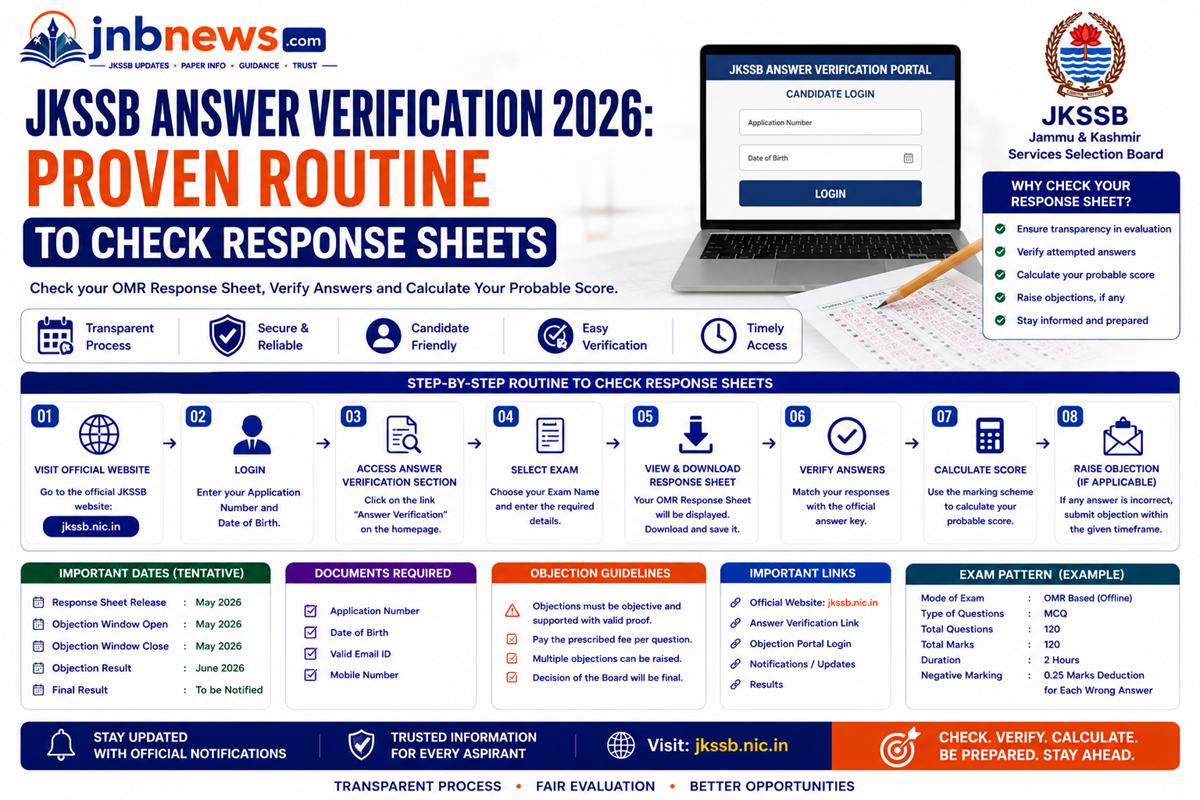
JKSSB Answer Verification 2026: Proven Routine to Check Response Sheets
Quick Answer
To build a massive competitive edge across high-stakes recruitment tracks, executing precise JKSSB answer verification 2026 routines is an absolute administrative necessity. The Jammu and Kashmir Services Selection Board structures its scoring checks through the systematic deployment of provisional series-wise answer keys and individual student duplicate response sheets immediately following written evaluations. This critical verification framework allows candidates targeting elite Sub Inspector (SI) and Accounts Assistant (FAA) portfolios to audit their marked answer sheets, evaluate question configurations across Series A, B, C, and D, and file structured representations safely by logging directly into the Official JKSSB Government Portal.
Introduction
Stepping out of the examination hall after competing for elite Sub Inspector or Accounts Assistant positions within the Jammu and Kashmir administration marks the transition into a critical administrative phase. For thousands of dedicated civil services test-takers across the Union Territory, true clarity does not come from tracking speculative forum scores or reading unverified chat predictions. Instead, it relies on mastering the formal JKSSB answer verification 2026 protocols managed by state board panels.
Relying on unofficial coaching keys or delaying your response sheet audit can cause you to miss tight objection windows, hurting your final merit standing.
To ensure your raw score estimates face zero technical or calculation errors, this comprehensive manual provides an authentic approach to handling your OMR performance sheets. By pairing a personal candidate dashboard verification workflow with official statutory regulations, we break down the mechanics of the series-wise answer grids, outline exact negative marking penalties, and guide you through subsequent administrative verification milestones with complete peace of mind.
Navigating the Examination Menu Pipeline
Staying fully informed during high-stakes preparation runs becomes incredibly simple when you follow a structured sequence. Official civil service documents are arranged in a specific order to streamline your tracking process:
- Exam Notifications & Job Advertisements: The primary structural files that outline active job openings, specific reservation grids, and age parameters.
- Admit Card Releases & Answer Keys: Operational assets required to verify your local testing center coordinates, check your responses against official solution sheets, and calculate score ranges.
- Result Announcements & Deployment Updates: Post-exam processing files used to view final cut-off listings, download detailed marksheets, and monitor provisional department assignments.
The Importance of Root-Level Verification
While tracking daily competitive alerts on curation platforms keeps your timeline organized, serious administrative aspirants must consistently execute root-level confirmations. Vital adjustments regarding final merit shifts, revised key distributions, or mandatory character verification layouts must always be verified straight from primary board logs to protect your profile standings. This routine shields your electronic file from unverified web modifications.
Technical Layout of the OMR Verification Matrix
The scoring architecture under the JKSSB answer verification 2026 framework implements a highly rigid, computerized objective screening layout designed to identify top administrative talents.
[Written OMR Evaluation] ──> Series-Wise Keys Released ──> Match with Candidate Carbon Copy
                                         │
[Objection Input Phase]  ──> Offline Proforma Filing  ──> Requires Authentic Textbook Proofs
                                         │
[Final Roster Processing] ──> Expert Committee Review ──> Locks Merit List and scorecards
1. Standard Scoring Parameters
The written assessment incorporates a maximum weightage of 120 questions to be solved inside a strict 2-hour execution window. Each question comprises four distinct response choices, requiring clean tracking accuracy from test-takers:
- Correct Response Output: Yields standard base score addition metrics as specified in the test instructions (+1 mark).
- Incorrect Selection Penalty: Triggers a strict negative marking penalty for wrong answers marked by the candidate (-0.25 marks or 25%). Recording multiple selections for a single row is automatically processed as an incorrect response.
- Unattempted Rows: Leaving a row completely blank incurs zero penalty marks, preserving your raw totals.
2. Layout of the Official Grievance Window
Following the publication of the provisional response ledger, the commission opens a short, non-extendable administrative window of exactly 3 working days for candidate cross-examinations. All objections must clear the secretariat’s entry gates before the designated deadline to guarantee a manual review by the academic committee.
Crucial Objection Management Guidelines
Succeeding under modern Union Territory civil service cycles requires matching your technical routines with the exact operational standards checked by commission parameters.
The Mandatory Offline Proforma Rules
As outlined under the official notification logs, candidates cannot file objections via casual email or phone networks. Grievance entries must utilize the physical, printed proforma layout (Annexure Form) exactly. Submissions must be delivered in person to the designated board offices located at either the JKSSB Office in Muthi, Jammu, or the JKSSB Office in the Zamzam Building, Rambagh, Srinagar.
Reference and Financial Fee Gates
To ensure that all logged challenges remain grounded in solid academic merit, submissions must meet rigid documentation standards:
- Authentic Reference Material: Every proforma page must have a physical copy of reference sheets attached, drawing directly from standard reference textbooks, academic journals, or primary statutory literature. Unverified internet links or casual web summaries will be rejected automatically.
- Fee Structure Requirements: Objections must be accompanied by a processing fee of $200 (or equivalent regional currency value) for every individual question being challenged, submitted via a standard Demand Draft drawn in favor of the Accounts Officer, JKSSB. The fee is fully refundable if the objection is found to be correct upon expert review.
Step-by-Step Blueprint to Verify Your Scorecard
Follow this practical, code-compliant routine to connect with the commission’s servers, manage your candidate settings, and pull your verification documents safely.
1. Download the Master Provisional Answer Key
Pull authentic, unedited blueprint PDFs straight from primary state files to align your qualifications correctly.
- Open your internet browser window and navigate straight to the Official JKSSB Government Portal.
- Locate the central ‘What’s New’ or ‘Latest Notifications’ section on the homepage layout.
- Click the link tracking the Provisional Answer Key Notice regarding Written Examination for your specific post cadre.
2. Cross-Reference Your Duplicate Response Sheet
Examine the master layout variables to calculate your tentative score spreads accurately without manual layout errors.
- Open the downloaded publication file, which lists the provisional solution metrics mapped series-wise across Sets A, B, C, and D.
- Retrieve your physical carbon copy sheet saved from exam day to align your marked options.
- Match your specific question item sequences carefully against the master reference columns, deduct negative penalties for wrong entries, and determine your net raw total.
3. Track Auxiliary External Linkages
To access additional contextual background analyses and external reporting covering regional civil service updates, view our specialized tracking partners:
- Read More Information on https://jnbnews.com
Common Pitfalls Candidates Must Avoid
Protect your preparation timeline from common administrative errors by keeping these exam-stage pitfalls in mind.
Entering Inaccurate Data Values Inside Your Profile
Entering incorrect graduation percentages or selecting the wrong community category options just to complete a form quickly can cause serious issues later. Even if you clear the high cut-off scores of the written phases, any mismatch between your digital form data and your physical certificates will lead to immediate disqualification during document verification. Treat every profile entry with absolute accuracy.
Grouping Multiple Question Objections on a Single Form Page
Assuming that you can comfortably list three or four different questioned items on a single proforma sheet to save time is a critical error. The board’s evaluation panel processes challenges through individual post codes and separate filing sequences. You must use a completely distinct, separate proforma page for every individual question being challenged to ensure all entries are processed properly.
Comprehensive Selection Verification Matrix
The detailed table below outlines the core parameters established for the active verification cycles.
| Core Post Cadre | Max Score Weightage | Default Series Layout | Mandatory Objection Window | Submission Mode Format |
| Sub Inspector (SI) | 120 Total Points | Series A, B, C, D | 3 Working Days from Release | Pure Offline Mode Only |
| Accounts Assistant (FAA) | 120 Total Points | Series A, B, C, D | 3 Working Days from Release | Pure Offline Mode Only |
Pros and Cons of Curated Key Monitoring
Pros
- Bypasses Server Timeout Blocks: Alternative tracking paths keep you from wasting hours refreshing frozen or overloaded home pages on result day.
- Clarifies Scoring Layouts: Clearly breaks down the question alignment grids so you can calculate your tentative totals smoothly.
- Speeds Up Objection Filing: Provides an explicit breakdown of the offline office addresses and fee matrices, saving you from administrative rejections.
Cons
- Demands Physical Document Delivery: Curation guides provide the forms, but delivering the signed proforma packs and demand drafts always requires manual handling at the board’s physical headquarters.
Frequently Asked Questions
Where can I check the official JKSSB answer verification 2026 data loops?
The provisional key sheets, question sets, and official objection forms can be downloaded directly by visiting the notification section on the Official JKSSB Government Website.
For how many days does the board keep the objection window open?
Candidates must finalize their response checks and submit formal challenges within a tight, non-extendable window of exactly 3 working days from the release date.
What is the mandated processing fee required to challenge an answer choice?
Aspirants are required to submit an online or offline processing fee of $200 (or equivalent regional currency value) per question, payable via a Demand Draft.
Is the objection processing fee refundable if my challenge is accepted?
Yes. The commission explicitly states that if the academic expert committee verifies your claim as correct, the fee for that question is fully refunded.
Can an applicant submit their response sheet challenges through online email portals?
No. To ensure proper tracking and authentication, all representations must be submitted strictly in physical offline mode at the Jammu or Srinagar board offices.
How does the negative marking penalty apply to incorrect selections?
For every incorrect option recorded on your OMR sheet, a negative penalty of one-fourth (25% or 0.25 marks) is automatically deducted from your correct totals.
What documentation must be attached to validate a response challenge?
Candidates must attach clear physical sheets drawn from standard academic textbooks, primary statutory regulations, or authoritative references. Casual internet blogs are rejected.
Where are the physical board offices located to submit objection papers?
Forms can be delivered to either the JKSSB Office in Muthi, Akhnoor Road, Jammu, or the JKSSB Office in the Zamzam Building, Rambagh, Srinagar.
What happens if I select multiple answers for a single question row?
Marking multiple choices for one question is automatically registered by automated scanners as an incorrect selection, triggering the 0.25 negative penalty.
How often should active candidates check for subsequent final answer keys?
Reviewing the official platform dashboard tabs two to three times a week ensures you capture final key updates, revised scorecards, and upcoming document verification dates early.
Final Verdict
Executing your JKSSB answer verification 2026 checks systematically is a critical milestone toward securing your place on final public service merit rosters. By stepping away from unverified social media chatter and using an organized, step-by-step approach through official portals, you can keep your evaluation calculations perfectly on track. This systematic focus protects your grievance submissions from unexpected format rejections and ensures your documentation aligns perfectly with commission parameters, letting you navigate your career milestones with complete confidence.
If you are ready to review your resource layouts or check current exam pattern adjustments, make the official state application servers a regular stop in your routine. By keeping your administrative timeline perfectly organized, you can approach your technical goals with peace of mind and secure your digital business milestones smoothly.
Technical Resources and References
External References
Review official notification logs, structural changes, and candidate system frameworks directly from primary state authorities:
- Jammu and Kashmir Services Selection Board Document Archives: https://jkssb.nic.in/
- JKSSB Online Candidate Portal Login Terminal: https://jkssb.nic.in/candidate/login
Read More Information on https://jnbnews.com