
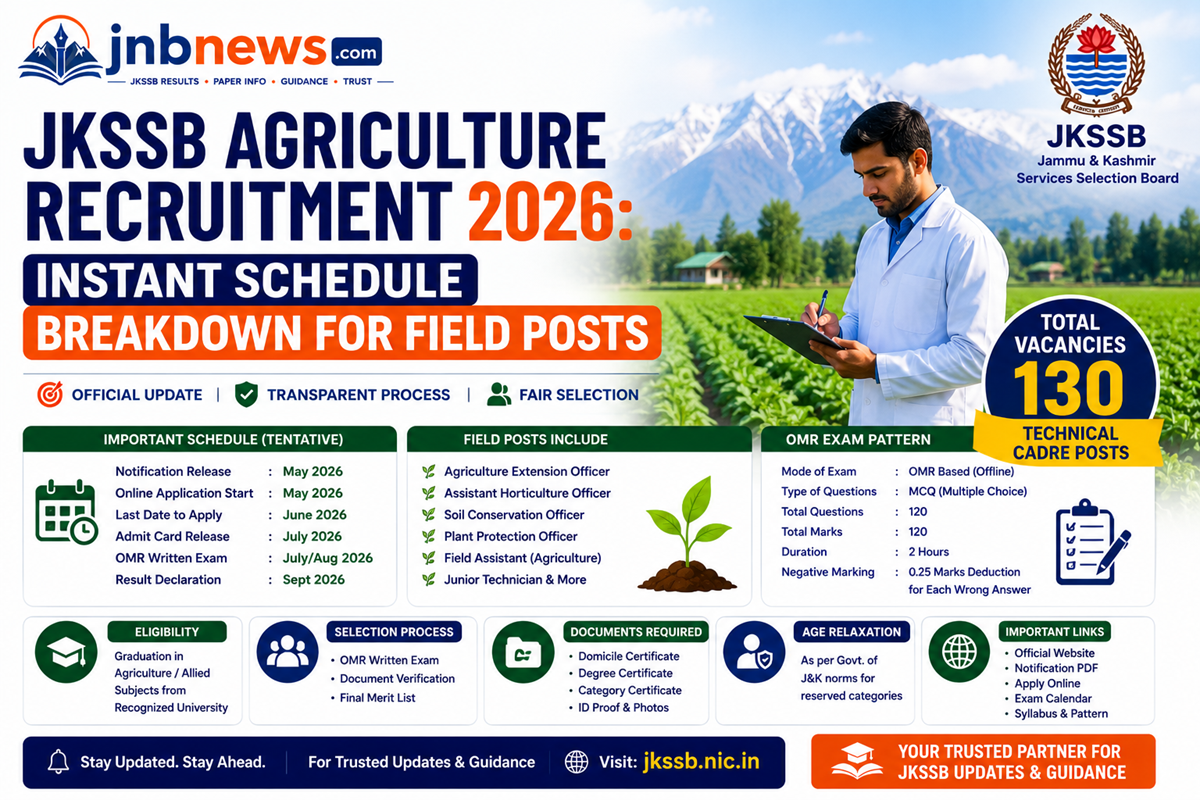
JKSSB Agriculture Recruitment 2026: Instant Schedule Breakdown for Field Posts
Quick Answer
To build a massive competitive edge across regional technical cadres, managing the JKSSB Agriculture Recruitment 2026 milestones requires a structured application routine. Formally authorized under Advertisement Notification No. 04 of 2026, the Jammu and Kashmir Services Selection Board has declared 130 fresh vacancies distributed across key administrative and field divisions, including the ARI & Trainings, Industries & Commerce, and Agriculture Production Departments. The online application window is officially scheduled to open on June 22, 2026, and will accept submissions until the final closing deadline on July 21, 2026. Aspirants can monitor registration access points and review upcoming test frameworks directly by visiting the Official JKSSB Government Portal.
Introduction
Securing a stable, decorated technical or field post within the agricultural administration of Jammu and Kashmir is an ambitious goal that demands rigorous subject discipline and timely tracking. For thousands of competitive aspirants across the Union Territory, understanding the exact parameters of the JKSSB Agriculture Recruitment 2026 cycle is the critical first milestone for structural success. True preparation does not begin with scanning heavy textbooks; it begins with thoroughly charting out the official registration timelines, qualification benchmarks, and selection criteria enforced by state boards.
Relying on out-of-date forum pages or waiting until the final hours of the registration window can leave you dealing with system overloads or missing critical credential mandates.
To protect your professional timeline from unexpected technical delays, this deep dive provides an authentic approach to navigating the upcoming application schedules. By pairing direct candidate dashboard practices with official board metrics, we break down how recent department vacancies are distributed, explain negative marking guidelines, and show you how to structure your core revision blocks with absolute peace of mind.
Navigating the Examination Menu Pipeline
Staying fully informed during high-stakes preparation runs becomes incredibly simple when you follow a structured sequence. Official civil service documents are arranged in a specific order to streamline your tracking process:
- Exam Notifications & Job Advertisements: The primary structural files that outline active job openings, specific reservation grids, and age parameters.
- Admit Card Releases & Answer Keys: Operational assets required to verify your local testing center coordinates, check your responses against official solution sheets, and calculate score ranges.
- Result Announcements & Merit Roster Lists: Post-exam processing files used to view final cut-off listings, analyze selection rosters, and view provisional department assignments.
The Importance of Root-Level Verification
While utilizing curated notification platforms keeps your study schedules organized, serious agricultural aspirants must consistently cross-reference data inputs with root government servers. Critical shifts regarding test timing rules, technical syllabus updates, or physical document parameters must always be verified straight from primary board releases before making final career updates. This protective routine shields your profile from unverified web modifications.
Technical Layout of the 130 New Vacancies
The structural vacancy distribution under the active JKSSB Agriculture Recruitment 2026 blueprint covers diverse cadres, pulling specialized candidates for technical assistant, supervisory, mechanical, and grading operations.
[JKSSB Advt 04/2026 Pool] ──> ARI & Trainings Department (42 Vacancy Seats)
                         ──> Industries & Commerce Department (34 Vacancy Seats)
                         ──> Home Department (21 Vacancy Seats)
                         ──> Agriculture Production Department (17 Vacancies)
                         ──> Higher Education & Law Wings (16 Vacancy Seats)
1. High-Volume Technical Infrastructure Portfolios
The single largest department indent belongs to the ARI & Trainings Department with 42 vacancies, followed closely by 34 openings under the Industries and Commerce Department. These sectors focus heavily on engineering diplomas and laboratory research configurations.
2. Specialized Agriculture and Horticulture Streams
The core Agriculture Production Department features 17 dedicated vacancies. This specialized track includes elite field options such as Senior Horticulture Technician positions (requiring a B.Sc. Horticulture or a B.Sc. Agriculture with a Horticulture major) alongside Junior Grader channels.
Crucial Timeline and Evaluation Parameters
Succeeding under modern Union Territory civil service cycles requires matching your technical routines with the exact operational standards checked by algorithmic grading machines.
The Official Registration Deadlines
Aspirants must keep close tabs on the following core schedules to ensure their application profiles pass system gates before automated cutoffs trigger:
- Commencement Date for Online Form Submissions: June 22, 2026.
- Final Closing Date for Applications & Fee Payment: July 21, 2026 (23:59 hours).
- Residency Cut-Off Boundary: All educational degrees and domicile proofs must be legally valid on or before July 21, 2026.
Written-Only OMR Selection Rules
To ensure complete transparency across all technical cadres, final placement under the JKSSB Agriculture Recruitment 2026 blueprint will be determined purely by merit performance in the objective written examination. The board has entirely removed separate oral interviews or viva-voce marks from this pipeline. The objective test is printed exclusively in English and carries a strict negative marking penalty of one-fourth (25% or 0.25 marks) for every incorrect selection.
Step-by-Step Blueprint to Execute Your Registration
Follow this practical, code-compliant routine to check your eligibility, build your candidate profile, and lock in your application details safely.
1. Download the Master Government PDF Archive
Pull authentic, unedited blueprint PDFs straight from primary state files to align your qualifications correctly.
- Open your web browser and navigate directly to the primary Official JKSSB Government Website.
- Locate the central ‘Notifications’ dashboard panel on the homepage layout.
- Click the download link next to Advertisement No. 04 of 2026 to save the complete terms, conditions, and job codes straight to your local storage drive.
2. Set Up Your Candidate Account Profile
Complete your registration setup early to ensure your application form passes automatic validation loops smoothly.
- Connect to the secure submission application sub-domain hosted on the official portal.
- Register using a valid email identity string and an active mobile number to generate your login credentials.
- Log into your workspace, fill in your personal data fields, and upload a recent live photograph along with your signature.
3. Clear the Online Fee Gate Requirements
Lock in your choice of cadres by clearing the mandatory application processing fee before the window shuts.
- Select your specific technical or field job code from the active menu options.
- Process your payment securely via integrated Net Banking, Debit Card, or Credit Card portals. General Open Merit applicants require a ₹600 fee, while SC, ST, EWS, and PwBD categories pay ₹500.
- Save a copy of your completed application receipt to your local drive for verification checks.
Common Pitfalls Candidates Must Avoid
Protect your preparation timeline from common administrative errors by keeping these exam-stage pitfalls in mind.
Entering Inaccurate Data Values Inside Your Profile
Entering incorrect graduation percentages or selecting the wrong community category options just to complete a form quickly can cause serious issues later. Even if you clear the high cut-off scores of the written phases, any mismatch between your digital form data and your physical certificates will lead to immediate disqualification during document verification. Treat every profile entry with absolute accuracy.
Waiting Until the Final Closing Night to Submit Fees
Assuming that the application portal will run perfectly during the final hours before the July 21 cutoff is a high-risk gamble. Massive traffic surges from thousands of delayed applicants frequently cause payment gate timeouts and submission failures. Process your forms at least 5 to 6 days early to ensure your profile locks in safely.
Comprehensive Recruitment Summary Matrix
The detailed comparative table below outlines the core parameters established for the active 04/2026 notification cycle.
| Target Department Field | Total Seats | Prescribed Educational Baseline | Upper Age Boundary (OM) | Mandatory Registration Window |
| Agriculture Production | 17 Posts | Degree in Agriculture / Horticulture / Diploma | 40 Years Old | June 22 to July 21, 2026 |
| ARI & Trainings | 42 Posts | 10th Pass / ITI / Graduation Tiers | 40 Years Old | June 22 to July 21, 2026 |
| Industries & Commerce | 34 Posts | Post-Specific Technical Diploma / Degree | 40 Years Old | June 22 to July 21, 2026 |
| Home Department | 21 Posts | Graduate Degrees / Equivalent | 40 Years Old | June 22 to July 21, 2026 |
Pros and Cons of Curated Notification Tracking
Pros
- Prevents Missed Registration Windows: Keeps rolling application timelines, fee dates, and selection rules clearly organized, preventing missed windows.
- Saves Vital Study Hours: Gathers scattered department notices into a single scannable list, freeing up more time for your daily study blocks.
- Clarifies Target Core Metrics: Breaks down complex vacancy distributions logically so you can pick your ideal job codes easily.
Cons
- Requires Double-Checking Details: High-stakes category changes or shifting rules mean you must check official resources periodically to ensure total accuracy.
Frequently Asked Questions
When does the application window open for the JKSSB Agriculture Recruitment 2026?
The online submission portal is officially scheduled to open for candidate registrations starting on June 22, 2026.
What is the final deadline to apply for these technical and field openings?
Candidates must complete their form submissions and pay their processing fees before the window closes on July 21, 2026.
How many total vacancies are available across this recruitment pool?
The selection board has announced a cumulative total of 130 vacancies across various Union Territory, Divisional, and District cadres.
What is the application processing fee for general Open Merit applicants?
Aspirants applying under the Open Merit (OM) category are required to pay an online fee of ₹600.
What is the upper age limit enforced for general open candidates?
The maximum age ceiling for unreserved Open Merit applicants is locked at 40 years as of January 1, 2026.
Does the selection process include an interview or viva-voce stage?
No. Selections for all positions under this notification are determined purely by merit performance in the written objective OMR test.
What negative marking penalty is enforced for incorrect choices?
For every incorrect option marked on the OMR sheet, a negative penalty of one-fourth (25% or 0.25 marks) is automatically deducted.
Is a local domicile certificate required to qualify for these positions?
Yes. Applicants must hold a valid Domicile Certificate of the UT of Jammu and Kashmir issued by competent revenue officers to remain eligible for final selection.
What qualification is required for the Senior Horticulture Technician post?
Candidates matching this specific code must possess a B.Sc. Horticulture or a B.Sc. Agriculture with Horticulture as a major subject.
Can an applicant submit their form through physical offline channels?
No. To maintain full tracking speed and security, applications are processed strictly online through the board’s secure recruitment terminal.
Final Verdict
Analyzing the JKSSB Agriculture Recruitment 2026 application timelines systematically is the critical first step toward securing a stable public service career. By moving away from unverified social media chatter and using an organized approach via official tools, you can keep your preparation schedule perfectly on track. This systematic focus protects your profile from unexpected registration drops and ensures your documentation aligns with current requirements, letting you approach the upcoming exams with complete confidence.
If you are ready to review your qualifications or check your target department codes, make the official government server links a regular stop in your daily routine. By keeping your administrative timeline perfectly organized, you can approach your technical goals with peace of mind and secure your milestones smoothly.
Technical Resources and References
External References
Review official notification logs, structural changes, and candidate system frameworks directly from primary state authorities:
- Jammu and Kashmir Services Selection Board Document Archives: https://jkssb.nic.in/
- JKSSB Online Candidate Portal Access Terminal: https://jkssb.nic.in/candidate/login
Read More Information on https://jnbnews.com
Reviewing detailed breakdowns of newly released notification folders is incredibly valuable for mapping out your weekly study checklists. This JKSSB Agriculture Field Posts and Department Vacancy Analysis provides a precise, early walk-through covering post-specific qualification splits, age relaxations, and structural selection rules tailored for this active cycle. This video resource is highly relevant because it features an expert natural language overview detailing exactly how to configure your candidate profiles before the online registration doors unlock this month.