
JKSSB JE Electrical Recruitment 2026: Proven Study Roadmap to 292 Vacancies
Quick Answer
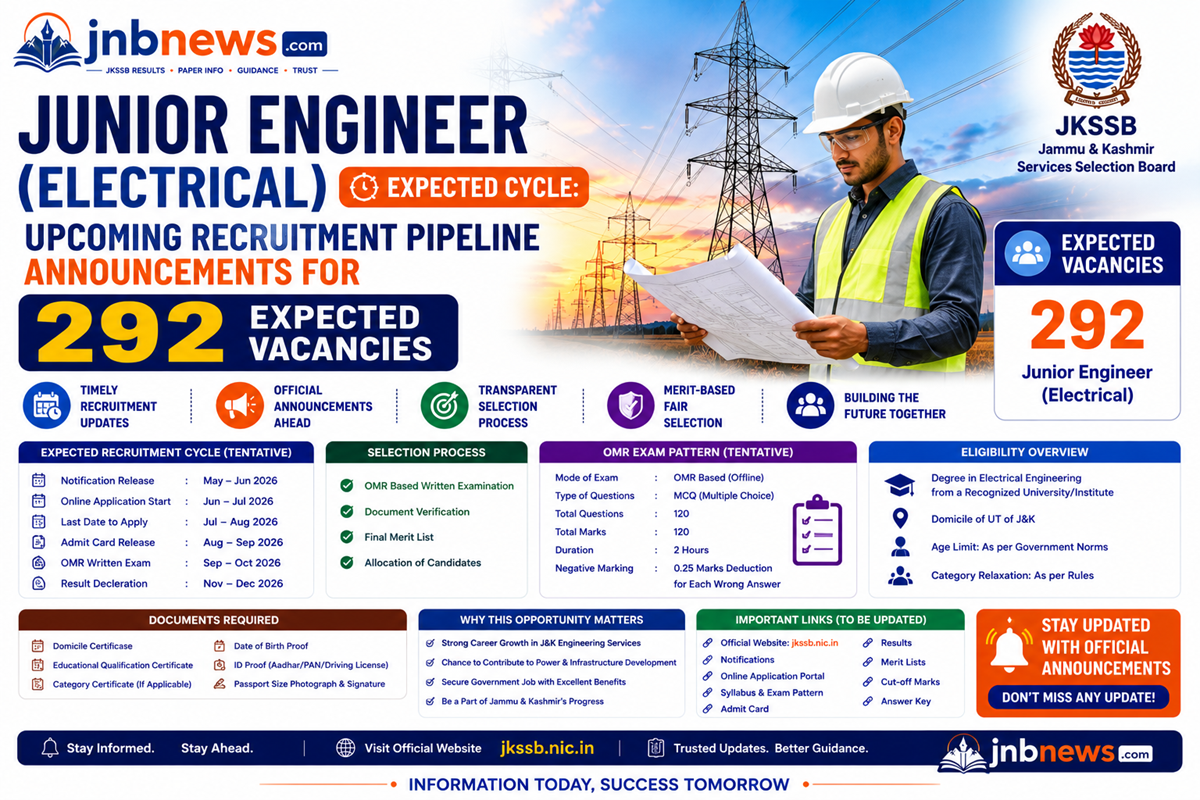
To secure a massive competitive edge ahead of high-stakes engineering cycles, preparing for the JKSSB JE Electrical Recruitment 2026 pipeline requires an organized technical training routine. The Jammu and Kashmir Services Selection Board is finalizing administrative clearances to officially announce 292 expected vacancies for Junior Engineer (Electrical) cadres under the Power Development Department (PDD). The selection architecture features an objective, OMR-based written examination (120 marks) followed directly by mandatory physical document matching lines. Aspirants can monitor active calendar rollouts, syllabus releases, and official portal registration portals by visiting the Official JKSSB Government Portal.
Introduction
Stepping out onto the path toward building an elite engineering career within the public infrastructure sectors of Jammu and Kashmir is a highly rewarding milestone. For hundreds of technical diploma and degree holders across the Union Territory, tracking the preparation requirements of the JKSSB JE Electrical Recruitment 2026 pipeline is the absolute baseline for structural success. True professional advancement cannot depend on unverified social channel tracking loops; it requires a direct analysis of the official curriculum bounds, age relaxations, and structural selection parameters enforced by state boards.
Relying on out-of-date notes or delaying your conceptual study blocks can cause unexpected performance failures on test day.
To keep your professional development schedule completely organized, this deep dive provides an authentic, comprehensive breakdown of the upcoming Junior Engineer electrical pipeline. By combining historical board data trends with current statutory guidelines, we outline how expected post quotas are distributed, explain complex negative scoring rules, and show you how to execute your technical mock revision drills with complete peace of mind.
Navigating the Examination Menu Pipeline
Staying fully informed during high-stakes preparation runs becomes incredibly simple when you follow a structured sequence. Official civil service documents are arranged in a specific order to streamline your tracking process:
- Exam Notifications & Job Advertisements: The primary structural files that outline active job openings, specific reservation grids, and age parameters.
- Admit Card Releases & Answer Keys: Operational assets required to verify your local testing center coordinates, check your responses against official solution sheets, and calculate score ranges.
- Result Announcements & Selection Lists: Post-exam processing files used to view final cut-off listings, download detailed provisional merit sheets, and monitor official department assignments.
The Importance of Root-Level Verification
While tracking daily competitive alerts on curation platforms keeps your timeline organized, serious engineering aspirants must consistently execute root-level confirmations. Vital adjustments regarding dynamic cutoff marks analysis, core curriculum weights, or physical identification guidelines must always be verified straight from primary board releases before making final career updates. This protective routine shields your profile from unverified web modifications.
Structural Distribution of the 292 Expected Vacancies
The upcoming JKSSB JE Electrical Recruitment 2026 allocation map targets core regional electrification grids and load dispatch maintenance stations. Reviewing the expected category-wise distribution boundaries allows you to evaluate your target cutoff fields early:
[JKSSB JE Electrical 292 Pool] ──> Open Merit Category (117 Expected Seats)
                               ──> Resident of Backward Area / RBA (29 Expected Seats)
                               ──> Scheduled Tribes / ST-1 & ST-2 (58 Expected Seats)
                               ──> Scheduled Castes / SC (23 Expected Seats)
                               ──> EWS & Other Social Castes (65 Expected Seats)
1. Unified Departmental Indents
All 292 positions are consolidated under the administrative umbrella of the Jammu & Kashmir Power Development Department (PDD). Selected candidates enter service under an authoritative Level-6 pay matrix scale (₹35,400 – ₹1,12,400), serving as primary execution officers across divisional and district cadres.
2. Essential Educational Qualification Thresholds
The selection board maintains rigid verification boundaries regarding professional technical eligibility. To clear the automated entry filters, candidates must possess one of the following credentials from a government-recognized university or technical institute:
- A 3-year Diploma in Electrical Engineering
- A full B.E. / B.Tech Degree in Electrical Engineering
- A valid AMIE Section (A&B) India engineering certification
Crucial Selection and Marking Parameters
Succeeding under the active JKSSB JE Electrical Recruitment 2026 matrix requires matching your daily study blocks with the exact evaluation standards verified by system scanners.
Written-Only Merit Rules
To ensure complete transparency across all technical cadres, final placement inside the selection roster is determined purely by merit performance in the objective written examination. The board completely operates without separate subjective viva-voce or interview marks in this engineering pipeline, making your OMR sheets the single deciding factor for your selection.
Detailed Scoring and Penalty Formats
The question paper booklet prints exclusively in the English language, compiling a maximum allocation of 120 objective questions over a 2-hour (120 minutes) execution window. For every incorrect choice recorded on your answer sheets, a strict negative marking penalty of one-fourth (25% or 0.25 marks) is automatically deducted from your accumulated total score. Blank, unattempted fields carry zero penalty marks.
Step-by-Step Blueprint to Prepare Your Strategy
Follow this practical, code-compliant routine to track incoming notification logs, check curriculum models, and organize your files safely.
1. Monitor Official Board Notification Portals
Capture fresh vacancy alerts and active application links directly from primary government server networks.
- Open your internet browser window and navigate directly to the Official JKSSB Government Portal.
- Locate the ‘What’s New’ dashboard array or open the ‘Notifications’ index panel.
- Isolate the specific Junior Engineer (Electrical) recruitment PDF to review exact online start and closing registration dates.
2. Download and Structure the Core Technical Syllabus
Map out your daily engineering review blocks strictly around the high-weightage topics checked by exam papers.
- Open the dedicated ‘Syllabus’ directory on the official portal to extract the specialized electrical guidelines.
- Divide your study timeline to spend 70% of your schedule mastering core technical modules, including Basic Electrical Concepts, Circuit Laws, Electrical Machines, Power Systems Generation/Transmission, and Network Theorems.
- Reserve the remaining 30% of your weekly preparation for basic analog/digital electronics and measurement frameworks to secure baseline cutoffs.
3. Organize Mandatory Residency Documentation
Ensure your personal credentials clear background validation checks well before the registration deadlines hit.
- Verify that your Domicile Certificate of the UT of Jammu and Kashmir is issued and stamped by competent revenue authorities, as local residency is a strict prerequisite for final job allocation.
- Check that your category certificates (RBA, SC, ST, EWS) are valid for the current fiscal cycle to secure lower selection thresholds.
Common Pitfalls Candidates Must Avoid
Protect your preparation timeline from common strategic errors by keeping these critical pitfalls in mind.
Entering Inaccurate Data Values Inside Your Profile
Entering incorrect graduation percentages or selecting the wrong community category options just to complete a form quickly can cause serious issues later. Even if you clear the high cut-off scores of the written phases, any mismatch between your digital form data and your physical certificates will lead to immediate disqualification during document verification. Treat every profile entry with absolute accuracy.
Ignoring Numerical Problem-Solving Drilling
Relying entirely on reading brief descriptive definitions while skipping deep mathematical derivations and numerical problem-solving drills is a major mistake. Competitive engineering tests evaluate your conceptual speed across complex circuit network calculations and machines formulas under strict time pressure. Practice solving multi-stage circuit models daily to keep your exam speed sharp.
Comprehensive Recruitment Summary Matrix
The detailed comparative table below outlines the expected parameters established for the upcoming civil engineering tier.
| Recruitment Cadre Post | Expected Vacancies | Managing Department | Required Age Boundary (OM) | Mandatory Exam Format |
| Junior Engineer (Electrical) | 292 Positions | Power Development Department (PDD) | 18 to 40 Years Old | Objective OMR (120 Questions) |
Pros and Cons of Early Strategy Configuration
Pros
- Builds Deep Concept Mastery: Starting your revision early gives you plenty of time to fully cover high-weightage power systems and machines chapters.
- Eliminates Gate Timing Panic: Organizing your certificates and diplomas weeks ahead of time ensures your portal submission goes smoothly.
- Maximizes Mock Performance: Leaving a larger window for timed sample papers lets you iron out negative marking errors systematically.
Cons
- Requires Sustained Motivation: Long preparation runs ahead of finalized examination calendars demand strict personal discipline to prevent study fatigue.
Frequently Asked Questions
Where can I check official updates for the JKSSB JE Electrical Recruitment 2026?
The detailed upcoming notifications, exam calendars, and registration gates will be activated directly on the Official JKSSB Government Portal.
How many total vacancies are expected for the Junior Engineer Electrical discipline?
The board has indicated an upcoming allocation pipeline of 292 vacancies designated for the electrical engineering stream.
Which government department will manage the final deployment of selected candidates?
All qualified engineering professionals will be placed into active field deployments under the Power Development Department (PDD).
What is the upper age limit enforced for unreserved general candidates?
Applicants competing under the general Open Merit (OM) category must not have crossed a maximum age ceiling of 40 years.
Is an engineering degree mandatory, or can diploma holders apply?
Both tracks are fully eligible. The board accepts a 3-year Diploma in Electrical Engineering as well as regular graduate B.E. / B.Tech degrees.
What is the structure and duration of the Junior Engineer written test?
The offline OMR written examination features 120 objective multiple-choice questions that must be answered within a strict 2-hour window.
What penalty applies to incorrect answers marked on the objective sheets?
For every incorrect choice recorded on the OMR sheet, a strict negative marking penalty of one-fourth (25% or 0.25 marks) is deducted.
Is a local domicile certificate required to qualify for these engineering posts?
Yes. Candidates must possess a valid Domicile Certificate of the UT of Jammu and Kashmir to clear document matching stages.
What is the base starting salary scale assigned to a selected Junior Engineer?
Selected professionals are appointed under Pay Level-6 (Scale ₹35,400 – ₹1,12,400) alongside standard allowances authorized by the UT administration.
How often should candidates monitor upcoming schedule announcements?
Reviewing official platform notifications two to three times a week ensures you stay well ahead of live registration opening windows, syllabi uploads, and admit card download timelines.
Final Verdict
Analyzing the JKSSB JE Electrical Recruitment 2026 pipeline layout systematically is the critical first milestone toward securing an elite public service engineering position. By moving away from unverified social media chatter and using an organized, step-by-step approach through official portals, you can keep your preparation schedule perfectly on track. This systematic focus protects your candidate profile from unexpected registration drops and ensures your technical documentation aligns with current requirements, letting you approach the upcoming test with complete confidence.
If you are ready to review your qualifications or check your target department codes, make the official government server links a regular stop in your daily routine. By keeping your administrative timeline perfectly organized, you can approach your technical goals with peace of mind and secure your milestones smoothly.
Technical Resources and References
External References
Review official notification logs, structural changes, and candidate system frameworks directly from primary state authorities:
- Jammu and Kashmir Services Selection Board Document Archives: https://jkssb.nic.in/
- JKSSB Online Candidate Portal Login Terminal: https://jkssb.nic.in/candidate/login
Read More Information on https://jnbnews.com
Reviewing professional overviews of upcoming engineering pipelines can give you a massive advantage when structuring your weekly revision trackers. This JKSSB JE 2026 Upcoming Vacancy Overview and Eligibility Breakdown outlines essential category-wise seat reserves, expected notification deployment trends, and targeted preparation strategies for the Power Development Department pipeline this year. This video resource is highly valuable because it provides a clear natural language roadmap detailing exactly how to balance your basic circuits and machines revisions before the official registration portal links go live.